


‘Fossil’ Pliers Show Rock Doesn’t Need Millions of Years to Form
on
December 1, 1991
Originally published in Creation 14, no 1 (December 1991): 20.
Contrary to evolutionary claims, rock can form in a very short time, as shown by the example of the pliers.
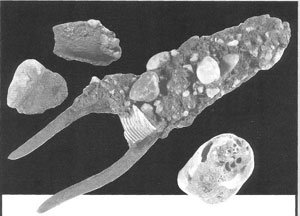
This photo shows a rock-hard concretion of naturally accumulated sand and pebbles of varying sizes (plus a sea-shell fragment).
This has accumulated around what is obviously a modern pair of pliers, as can be seen by the exposed handles. The ‘rock’ around these lower parts has been broken off—the two fragments shown form part of a cast of the shape of the handles.
The pliers were found in July 1989 by Kevin Skemian. He picked them out of a shallow rock pool at the beach at Alexandra Headland on Queensland’s Sunshine Coast (Australia). They were lying in sandy grit on the bottom of the pool in about 15 centimetres (six inches) of water.
 Kevin said that at the time he found the pliers, they
were completely covered with ‘encrustation’, except for
the end of one of the handles, where the coating had
broken off. ‘I thought they had probably fallen out of
someone’s fishing bag’, Kevin said. ‘They looked so old,
but couldn’t be that old.’ He said he expected the rust to
be soft and just fall away when he disturbed it. But it
didn’t.
Kevin said that at the time he found the pliers, they
were completely covered with ‘encrustation’, except for
the end of one of the handles, where the coating had
broken off. ‘I thought they had probably fallen out of
someone’s fishing bag’, Kevin said. ‘They looked so old,
but couldn’t be that old.’ He said he expected the rust to
be soft and just fall away when he disturbed it. But it
didn’t.
The coating has become more brittle with time, and some pieces have now broken off. This shows that rock need not take a long time to form, as most people wrongly believe.
Support the creation/gospel message by donating or getting involved!

Answers in Genesis is an apologetics ministry, dedicated to helping Christians defend their faith and proclaim the good news of Jesus Christ.
- Customer Service 800.778.3390
- Available Monday–Friday | 9 AM–5 PM ET
- © 2026 Answers in Genesis