


The 'Oldest Known Fly'—A Lesson in Caution
Originally published in Creation 14, no 3 (June 1992): 6.
Evolutionists generally believe that insects with two wings have evolved from the ‘more primitive’ or ‘unspecialized’ four-winged condition.
If pressed for evidence, they would generally refer to the fossil of ‘the oldest known fly’—a specimen called Permotipula.
‘Archaeopteryx Of The Flies’
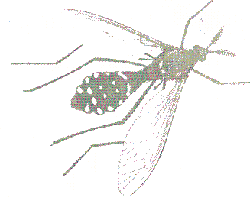
Though not quite as widely known as other alleged ‘links’, Permotipula has nevertheless achieved quite a status as a definite ‘in-between form’. It was discovered in Australia more than 50 years ago.1 However, all that it consisted of was a single wing, which was subsequently lost. Its name comes from the fact that it was found in Permian rock and was believed to be comparable to the wing of the familiar dipterous (two-winged) craneflies Tipulidae. In subsequent works dealing with the evolution of insects,2,3 we find quotations referring to Permotipula—yet this one fossil wing has curiously ‘metamorphosed’ in the literature into the remains of an insect with four wings. Thus, it became enshrined as a four-winged ancestor of the two-winged flies and midges of modern times (Diptera).
Embarrasing Rediscovery
However, the fossil has been rediscovered —in the British Museum. A fresh study of the wing venation (the arrangement of veins) has shown that one character which was believed to be indicative of a close relalionship to the Diptera is absent, and that ‘Permotipula cannot be one of the direct ancestors of the recent Diptera’.4 Not only that, but it is of course painfully obvious that a single wing cannot, in any case, be trumpeted as proof that its owner had four.
All this goes to show how cautious one must be whenever a discovery of an ‘unspecialized ancestor’ of some animal or plant is hailed in the literature.
Footnotes
- Tillyard, R.J., in Nature, p. 778, 1929 (quoted in Tillyard, ‘The ancestors of Diptera’, Nature, 139, 1937).
- Henning, W., Insect Phylogeny, Chichester, New York, 1981.
- Rohdendorf, B.B., The Historical Development of Diptera, Edmonton, 1974.
- WillMann, R., ’Rediscovered: Permotipula patricia, the oldest known fly’, Naturwissenschaften 76, 375-377, 1989.
Support the creation/gospel message by donating or getting involved!

Answers in Genesis is an apologetics ministry, dedicated to helping Christians defend their faith and proclaim the good news of Jesus Christ.
- Customer Service 800.778.3390
- Available Monday–Friday | 9 AM–5 PM ET
- © 2026 Answers in Genesis