Answers magazine is the Bible-affirming, creation-based magazine from Answers in Genesis. In it you will find fascinating content and stunning photographs that present creation and worldview articles along with relevant cultural topics from different authors. Each quarterly issue includes a detachable chart, a pullout children’s magazine, a unique animal highlight, excellent layman and semi-technical articles plus bonus content from the AnswersMagazine.com website. Our purpose is to equip you, our reader, with practical answers so you can confidently communicate the gospel and biblical authority with accuracy. Why wait? Subscribe today!
Creation Archive > Volume 19 Issue 2 > From the beginning of the creation
First published: Creation 19(2):35–38 March 1997 | ||
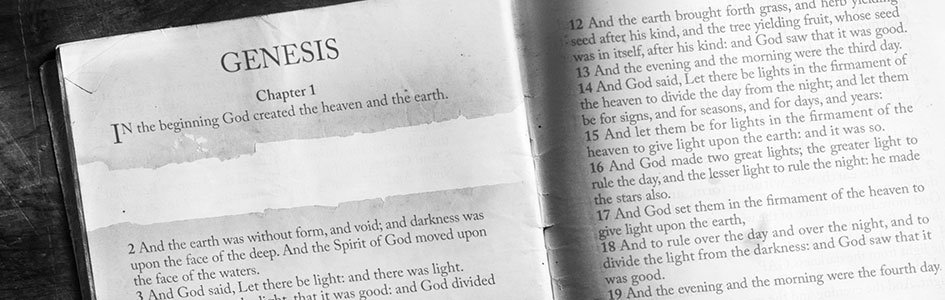
Is there a ‘gap’ of billions of years, in between verse 1 and verse 2 of Genesis chapter 1, into which Christians can conveniently assign the long ages claimed by evolutionary geologists?1,2
The most obvious and straightforward reading of Genesis 1 provides a prima facie case that Moses, under the direction of God, intended to write a literal historic account of what God had revealed to him (or to his antecedents), and not a cryptic message with clues for the super-intelligent. In other words, if God had meant us to understand that there was a gap of billions of years between verses 1 and 2, involving so many details about Satan, sin, judgment, punishment, re-creation, etc., we might reasonably expect that He would have provided the author with at least some of these alleged details. He did not. Nor are they to be found anywhere else in the Bible.3
In fact, orthodox Jews and conservative Christians have always read Genesis 1 as literal history. Prof. Davis Young, a theistic evolutionist geologist, admits:
‘It cannot be denied, in spite of frequent interpretations of Genesis 1 that departed from the rigidly literal, that the almost universal view of the Christian world until the 18th century was that the Earth was only a few thousand years old. Not until the development of modern scientific investigation of the Earth itself would this view be called into question within the church.’ 4
Genesis 1:31 says, ‘And God saw every thing that He had made, and behold it was very good.’ [The Hebrew is meod tov, which indicates perfection, a complete absence of evil of any kind, as Calvin and many other commentators have pointed out.] This is hardly an accurate description, if the being who became Satan had already rebelled! And if there were billions of ‘Lucifer-flood’ fossils with the marks of disease, violence, death, and decay, corresponding to the perishing of an entire pre-Adamic race and the extinction of a complete world of animals, with Adam and Eve walking around on top of buried fossils, how could God have called all this ‘very good’?5 (In their monumental Old Testament commentary, Keil and Delitzsch say about ‘very good’ in Gen. 1:31: ‘everything was perfect in its kind … the existence of anything evil in the creation of God is absolutely denied, and the hypothesis entirely refuted, that the six days’ work merely subdued and fettered an ungodly, evil principle, which had already forced its way into it.’)
Genesis 6–9 describes a worldwide flood in which all the air-breathing land animals which were not on Noah’s Ark died. As gappists assign the fossils to ‘Lucifer’s flood’, they are forced to conclude that Noah’s Flood left virtually no trace or was merely local. Surely a flood which is explicitly described in the Bible is a better source of the fossils than a hypothetical flood which the Bible does not mention at all!
Exodus 20:11 says, ‘For in six days the Lord made heaven and earth, the sea, and all that in them is …’ This is the definitive verse outside Genesis concerning the time frame of creation. It states categorically that God created everything in six days. There is just no allowance for a gap.6
Romans 5:12 states, ‘… by one man (Adam) sin entered into the world, and death by sin …’ Adam was created on Day Six, but the classical gap theory says there was death during the gap before Day One. Not so, according to the Apostle Paul! This verse plainly says that death entered the world because of (and so after) Adam’s sin. There is nothing to restrict this verse to human death; on the contrary, Romans 8:20 says that the whole creation was made ‘subject to vanity’. Death could not therefore have been in the world (with fossils killed in the alleged ‘Lucifer’s flood’) before Adam sinned. Gappists must therefore say that Romans 5:12 and Genesis 3:3 refer only to spiritual death. This is not so. Adam began to die physically (Hebrew: ‘dying you will die’, that is, the process of dying would begin—Genesis 3:19, completed in Genesis 5:5), and he also died spiritually.7 Jesus experienced both physical death and spiritual death (Matthew 27:46) for us on the cross. See also 1 Corinthians 15:21–22.
What is the gap theory?The gap theory is an attempt by some Christian theologians to make Genesis fit the popular belief that the universe is exceedingly old. Gappists believe in a literal Genesis, but accept an extremely long age (undefined) for the earth. To reconcile these views, they fit the geological ages between verses 1 and 2 of Genesis 1. However, they are opposed to evolution. According to Weston W. Fields, author of the definitive anti-gap book Unformed and Unfilled, the traditional or classical gap theory can be summarized as follows: ‘In the far distant dateless past God created a perfect heaven and perfect earth. Satan was ruler of the earth which was peopled by a race of ‘men’ without any souls. Eventually, Satan, who dwelled in a garden of Eden composed of minerals (Ezekiel 28), rebelled by desiring to become like God (Isaiah 14). Because of Satan’s fall, sin entered the universe and brought on the earth God’s judgment in the form of a flood (indicated by the water of 1:2), and then a global Ice Age when the light and heat from the sun were somehow removed. All the plant, animal, and human fossils upon the earth today date from this ‘Lucifer’s flood’ and do not bear any genetic relationship with the plants, animals and fossils living upon the earth today ...’ (Ref. 6, p. 7). Today’s creatures are a result of a 6-day recreation. Note, however, that recently a new type of gap theory has surfaced in which there is no ruin or reconstruction; proponents just postulate a lengthy time gap only, with either ancient stars, an ancient earth, or both. |
Gappists’ arguments depend heavily on revisionist translations of a few Hebrew words.
The Hebrew words bara (‘create out of nothing’) and asah (‘make’).
Genesis 1:1 uses bara and Exodus 20:11 uses asah. Gappists claim that Exodus 20:11 refers to a re-creating and re-forming of a ruined world because, they claim, bara and asah cannot be used interchangeably.
Answer: The Hebrew word bara is used three times in Genesis 1, each representing the creation of a completely new entity—something which did not exist before.
In Genesis 1:1, bara is used of the creation of heavens and earth.
In Genesis 1:21, bara is used of the creation of the first conscious animal (or nephesh) life.
In Genesis 1:27, bara is used of the creation of the first man, i.e. human life—made in God’s image.
But Genesis 1:26 quotes God as saying, ‘Let us make (asah) man in our image’, whereas the very next verse says, ‘So God created [bara] man in His own image.’ The same event is here described by both bara and asah, so the verbs are obviously used interchangeably—the passage is Hebrew parallelism. Furthermore Genesis 2:4 says, ‘These are the generations of the heavens and of the earth when they were created (bara), in the day that the Lord God made (asah) the earth and the heavens’. Here bara and asah are again used together in synonymous parallelism, again showing that they are used interchangeably by Moses.
Sometimes asah is clearly used to mean create ex nihilo (out of nothing), despite gappists’ claims to the contrary, e.g. Nehemiah 9:6:
You alone are the LORD. You made (asah) the heavens, even the highest heavens, and all their starry host, the earth and all that is on it, the seas and all that is in them. You give life to everything, and the multitudes of heaven worship you.
Such a waw disjunctive is easy to tell from the Hebrew, because it is formed by waw followed by a non-verb. It introduces a parenthetic statement, that is, it’s alerting the reader to put the following passage in brackets, as it were—a descriptive phrase about the previous noun. It does not indicate something following in a time sequence—this would have been indicated by a different Hebrew construction called the waw consecutive, where waw is followed by a verb [the waw consecutive is in fact used before the different days of creation (see Creation at the academy (Dr Doug Kelly interview)]. Thus the Hebrew grammar shows that a better translation of Genesis 1:2 would be, ‘Now the earth …’, and it could be paraphrased, ‘Now as far as the earth was concerned …’.10
It is as if the author of Genesis (under God’s direction), by the use of such a joining word, is going out of his way to stress that there is no break between the two verses.
However, recognized grammarians, lexicographers, and linguists have almost uniformly rejected the translations ‘became’ and ‘had become’.11 It is a basic exegetical fallacy to claim that because Strong’s Concordance lists ‘became’ as one of the meanings of haya, it is legitimate to translate it this way in the particular context of Genesis 1:2. It is simply grammatically impossible when the verb haya is combined with a waw disjunctive—in the rest of the Old Testament, Waw + a noun + haya (qal perfect, 3rd person) is always translated, ‘was’ or ‘came’, but never ‘became’.
Some have misused Jeremiah 4:23 to teach the gap theory, because it uses the phrase tohu va bohu to describe the results of a judgment. Leading gap theorists like Arthur Custance used this fact to assert that ‘without form and void’ must mean ‘laid waste by a judgment’. But this is fallacious—there is nothing in the Hebrew words tohu VA bohu themselves to suggest that. The only reason they refer to being ‘laid waste’ is due to the context in which the words are found. They simply mean ‘unformed and unfilled’. This state can be due either to nothing else having been created, or some created things being removed. The context of Jeremiah 4 is a prophecy of the Babylonian sacking of Jerusalem, not creation. In fact, Jeremiah 4:23 is known as a literary allusion to Genesis 1:2—the judgment would be so severe that it would be leave the final state as empty as the world before God created anything. Jeremiah 4:23 cannot be used to interpret Gen. 1:2 as a judgment—that would be completely back-to-front, because an allusion works only one-way.
An analogy: when I open my word processor, my document screen is blank. But if I delete an entire document the screen would likewise be blank. So ‘blank’ means ‘free from any text’. In some contexts, the lack of text is because I haven’t written anything, in others it is due to a deletion of text. You would need to know the context to tell which—you couldn’t tell from the word ‘blank’ itself. However, a Custance-type analysis of the word might conclude, ‘“blank” can refer to a screen with all the text deleted, so the word “blank” itself signifies a text deletion event, even when none is stated.’
The English word ‘replenish’ in the KJV translation of Genesis 1:28 (‘… and God said unto them, Be fruitful and multiply and replenish the earth’), does not support the gap theory as gappists claim. Linguist DR Charles Taylor writes, ‘As translated in 1611, it (‘replenish’) was merely a parallel to ‘fill’, and the prefix ‘re-’ didn’t mean ‘again’, but ‘completely’.14 The same Hebrew word male is used in Genesis 1:22, and is there translated ‘fill (the seas)’, so there was no need to translate it differently in verse 28. (See also What does replenish the earth mean?)
The darkness. Since ‘God is light’ (1 John 1:5), and in the Bible ‘darkness’ is sometimes used as a metaphor for judgment of the wicked (Exodus 10:21, Isaiah 13:10, Joel 2:31, Matthew 27:45, etc.), some (but not all) gappists have argued that Genesis 1:2 refers to an evil state. This is an error of logic. ‘The symbol has been confused with the thing symbolized, until the very symbol itself is now considered evil!’15
The earth could not have been anything but dark, because light had not yet been created. Indeed, Genesis 1:3, ‘And God said, Let there be light’, should alone be sufficient to undermine the gap theory. If the sun, moon and stars were all created (as even the newer gap theories insist) ‘in the beginning’ (Genesis 1:1), why was it necessary for God to create light (verse 3) after the alleged gap between verses 1 and 2?
Although the gap theory is well meant by its propagators, it is not confirmed by any data, whether linguistic, Biblical, theological, or practical. To advocate death before Adam sinned is contrary to the Biblical statements that death came as a result of Adam’s sin, which occasioned the necessity for man’s redemption through Christ’s death on the cross and His resurrection.
Where do the angels fit in?Exodus 20:11 says that God made all things in heaven and earth in six days. This must therefore have included the angels, all originally created good or holy (Colossians 1:16, Jude 6). Job 38:4 & 7 suggests that the angels (‘sons of God’) were present when God laid the foundations of the earth, i.e. created it on Day One (Genesis 1:1), before He created light. Angels, being spirit beings, don’t have eyes with human retinas, and so presumably can see in the dark even as God can. This raises the question as to when these beings rebelled to give rise to Satan and his demonic followers (2 Peter 2:4, Jude 6). This was surely not possible before God pronounced everything as being ‘very good’ near the end of Day Six (Genesis 1:31). Some gappists say that there was not enough time after Day Six and before the events of Genesis 3 to allow for this rebellion. So how long was it? We do not know how long it was after Day Six (or Seven?) that the temptation of Eve occurred (Genesis 3). We can suppose that it must have been before Eve became able to conceive (Genesis 4:1), as Cain had a sinful nature, so must have been conceived after the Fall of his parents. Let us therefore suppose that there was only a week between Day Six and the (human) Fall. Is this enough time? Consider:
We conclude therefore that the time needed for the rebellion of the angels does not require there to be a ‘gap’ in Genesis 1 between verse 1 and 2, and such a notion conflicts with everything being described by God as ‘very good’ at the end of Day Six. |
Help keep these daily articles coming. Find out how to support AiG.