

Fascinating Cuttlefish
Originally published in Creation 19, no 2 (March 1997): 26-28.
With green blood, three hearts, and able to change colour in a flash, it sounds like a ‘weird aliens’ movie creature. Actually, the cuttlefish is a seafood delicacy.
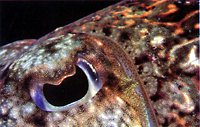
The eye of the cuttlefish, like that of the squid, has a very similar design to our own—but evolutionists must believe both eye types evolved separately, so the similarity is just a ‘coincidence’.
The world’s oceans are filled with amazingly complex creatures, perhaps none more so than the cuttlefish. This fascinating mollusk is probably best known for its cuttlebone, usually found at the bottom of budgie cages. However, the cuttlefish is much more than just a calcium supplement for caged birds.
In addition to being able to camouflage itself in a range of environments, the cuttlefish is able to change colour spectacularly when excited, flashing rapidly from yellow to red-orange and blue-green.
It also has a complex propulsion and buoyancy system (the latter similar to that used in submarines), and a sharp ‘beak’ which allows it to cut open flesh like a pair of scissors, so it can use its tentacles to tear out meat.
Socially, the giant Australian cuttlefish is a favorite with divers during breeding season, when the usually shy marine creature becomes outgoing, following divers through the water and often holding still for a scratch or pat.1
The cuttlefish belongs to the mollusk class Cephalopoda—which means ‘head-footed’ derived from the Greek words kephale (head) and podes (feet)—ranging from 2.4 centimetres (around one inch) to 90 centimetres (three feet) in length (even bigger in the case of the giant Australian cuttlefish, which can reach the length of a small man).
Cuttlefish evolution? Think again
Classification2:
Phylum: Mollusca
Class: Cephalopoda
Subclass: Dibrachiata
Order: Sepioida
Family: Sepiidae
Genus: Sepia
Like every animal phylum (a major division of life), the mollusks appear with no ancestors in the so-called Cambrian rocks. (A hypothetical archimollusc is set forth as the ancestor of all mollusks, but is not found in the fossil record.)3 The class Cephalopods appear in the fossil record in Ordovician rocks, again without evolutionary transition.
Encyclopedia Britannica says of the cephalopods, ‘Phylogenetic [evolutionary] linkages are still highly theoretical …’.4 The order sepioids appears in rocks no lower than the Jurassic system, again with no transitions leading to them. It is possible that all fossil and living sepioids may be the descendants of one ancestral created kind, based on the structural variation described in fossils.5
Cuttlefish blood looks blue-green because it uses the pigment hemocyanin to carry oxygen, unlike our blood which uses the red pigment hemoglobin. The cuttlefish has three hearts—one for each set of gills, and one for the rest of the body.
It has eight sucker-lined arms and two prehensile tentacles (which can be withdrawn into pouches under the eyes), and mainly feeds on fish, crustaceans and other mollusks. It hunts in the daylight, catching nocturnal prawns by blowing with its funnel and jetting them out of the sand. Like an octopus, the cuttlefish produces ‘ink’, in this case a brown fluid called sepia. However, it uses this defence only as a last resort, preferring to rely on its extensive camouflage capabilities both to hunt prey and avoid its own predators, such as sharks and dolphins.
The cuttlefish has a skin comprising three layers of chromatophores (colour pigment cells)—a bright yellow layer near the surface, under which is an orange-red layer and finally a dark base. Transformation from one colour to another, which can take less than a second, is controlled by the nervous system. In just a few seconds, it can run a whole gamut of colours.
The cuttlefish propels itself using a series of spurts, drawing water into a compression chamber which it squeezes to jet the water out a funnel under the head. Direction changes can be made by swivelling the nozzle of this funnel, and narrowing the funnel controls speed.
Like a submarine, the cuttlefish fills tiny compartments in its cuttlebone with gas to help maintain neutral buoyancy. This helps the cephalopod hover above the ocean floor, because although it has a sophisticated propulsion system its large cuttlebone does not allow it to be overly active, or quick in the water. It is hard to imagine how this slow-paced species could have survived over millions of years of evolution before it developed its all-important camouflage capabilities, yet evolutionists believe this, even though there is no evidence to show how such features developed.
The cuttlefish also has eyes which are similar in construction to human eyes, but evolutionists do not believe it has any direct evolutionary relationship to humans (i.e. there is no possible ancestor to both cuttlefish and humans which could have had such an eye) . So this similarity is explained away as ‘convergent evolution’: the eyes of the cuttlefish and other cephalopods ‘evolved independently’ to humans. In other words, it is simply an evolutionary coincidence.
However, the similarity in the design of both the cuttlefish and human eye is easily explained—they had the same Designer! The origins of the amazing features of the cuttlefish can be more easily explained if we accept it as just another miraculous example of the work of the Creator.
Staying neutral
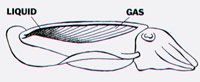
Redrawn after Clarkson, E., Invertebrate Palaeontology and Evolution, George Allen and Unwin, London, 1979 (Seventh impression 1984), p.167.
The cuttlefish is a bottom-dweller which often lies in ambush for smaller animals. For this way of life, it needs to keep itself at neutral buoyancy, so that it neither sinks nor rises. At first glance, it would seem sufficient for the Creator to have endowed it with a fixed overall density, so that its own weight was exactly balanced by the upthrust of the surrounding water.
However, if the depth changes, so will the amount of ‘lift’ from the water. Therefore in order to be able to operate at varying depths and water densities, cuttlefish need to be able to adjust their overall density so as to always remain ‘neutral’ in the water. The cuttlefish does this by an ingenious mechanism. The bony shell actually has many narrow chambers. If these were all filled with gas, they would give a lift of up to 4% of the animal’s weight. However, they are only part-filled with gas—the darker areas shown are where it is part-filled with liquid. The cuttlefish is able to pump liquid in and out of that section as needed to keep the buoyancy ‘just right’.
Other resources:
- ‘The Giant Australian Cuttlefish’, Geo 9(1), March–May 1987, pp. 58–71.
- Encyclopedia Britannica, (fifteenth edition), 3:814, 1992.
Footnotes
- ‘Dolphins frolic as a seasonal tragedy unfolds beneath’, Sydney Morning Herald, September 14, 1996.
- R. Moore, C. Lalicker, and A. Fischer, Invertebrate Fossils, McGraw Hill, New York, 1952.
- Clarkson, Invertebrate Paleontology and Evolution, George Allen & Unwin, London (7th impression), 1984.
- Encyclopædia Britannica, (fifteenth edition), 24:322, 1992.
- Ref. 1., chapter 8, ‘mollusks’.

Support the creation/gospel message by donating or getting involved!

Answers in Genesis is an apologetics ministry, dedicated to helping Christians defend their faith and proclaim the good news of Jesus Christ.
- Customer Service 800.778.3390
- Available Monday–Friday | 9 AM–5 PM ET
- © 2026 Answers in Genesis