

The Magnificent Migrating Monarch
An Electronic Design Expert Ponders the Stunning Navigational Exploits of the Monarch Butterfly.
Originally published in Creation 20, no 1 (December 1997): 28-31.
This tiny, yet beautiful, insect can perform a migration flight of thousands of kilometres, navigating unerringly to reach a place it has never seen.
In the many years I worked as a specialist design engineer, I came across (and designed parts for) some very sophisticated electronic gadgetry, including navigation equipment for various space and defence projects. The level of technology in the circuits that guided men to the moon is phenomenal. However, the navigation equipment packed into the brain of the monarch butterfly shows, through the incredible feats of migration performed by that creature, that there is a far greater level of technology involved. And it is all packed into a brain no bigger than a pinhead!
This tiny, yet beautiful, insect can perform a migration flight of thousands of kilometres, navigating unerringly to reach a place it has never seen. For instance, some monarchs fly from Nova Scotia, Canada to the mountains west of Mexico City, some 5,000 kilometres (3,000 miles) in all. Not just to the very same place to which their forefathers migrated, but each one often to the very same tree!
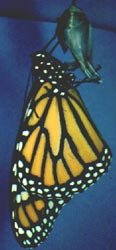
The monarch butterfly, about 4 cm (1.5 inches) long and weighing half a gram. Each one of its four wings has about 1.4 million scales. Every scale is filled with air to provide buoyancy and make it easier to fly. Design engineer Jules Poirier, who has worked on various space projects, told Creation magazine: ‘only a great Creator could have designed such a wonderful flying machine’.
Monarch butterflies can fly in still air at a speed of around 50 kilometres (30 miles) per hour, and considerably faster with a tail wind. They usually fly close to the ground, but have been found as high as 3,500 metres (12,000 feet).1 They have been known to fly more than 600 kilometres (375 miles) over water non-stop in 16 hours. Their 5,000 kilometre migration takes them eight to ten weeks, travelling only in daylight.
Monarchs can be taken hundreds of kilometres off course and still find their way to their destination. How do they perform this amazing feat? To this day, no scientist knows for certain. It looks as if they have magnetic material in their head and thorax region, so they may use the earth’s magnetic field to help them. However, most scientists believe they only use the earth’s magnetism to give them the general direction. They use the sun’s position for most of their navigation, to locate where they are on the earth’s surface.
It is instructive to look at the two basic systems by which humans can fix their position using the sun. Monarchs wouldn’t use exactly the same sorts of systems as humans do, but they would have to solve essentially the same basic problems.
-
Method 1: To work out the latitude of your position on the earth (i.e., how far you are north or south of the Equator), you note the time the sun just rises above the eastern horizon in the morning on a given date, and look up the relevant tables for that day in the Navigator’s Almanac. To work out your longitude, you compare the time where you are with the time in Greenwich, England. Dividing the difference (in minutes) by four gives the degrees of longitude.
-
Method 2: This requires that at least two sightings of the sun’s position relative to the horizon are taken at two different times. From the first measurement (and by using an almanac which tells you what the sun’s position is on a certain date and knowing the Greenwich time) a line can be drawn and the navigator can say ‘I’m somewhere along that line’. The second measurement gives another line, and where they intersect gives the navigator’s approximate position.
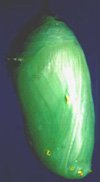
The pupa from which the adult monarch emerges after its spectacular transformation from a caterpillar
It is likely that the monarch butterfly uses something like the second method to determine its position on the earth.2 God must have programmed the monarch with a simplified almanac of the sun’s position relative to a date and time. This means that this butterfly also has to have an accurate internal clock. Monarchs can detect different polarizations of light, so even on a cloudy day, they can measure the angle to the sun from the horizon.3 Humans had to discover mathematics and a host of other things to be able to navigate much more crudely than this insect, which has it all programmed into it from birth.
The monarch’s life cycle is an amazing story in itself: the adult lays an egg, and from the egg, a caterpillar hatches. After it has grown enough, it makes a chrysalis and enters the pupa stage (see photo, right). Inside the chrysalis, the caterpillar’s tissues disintegrate and re-form into the adult butterfly. This process is powerful evidence of a designing hand, because until it was fully operational, the creature could not have reproduced. Imagine a hypothetical evolutionary intermediate stage: a caterpillar evolves the materials and instinct to make a chrysalis, then another enzyme to dissolve all its tissues. What happens then? A container full of a soup of cells that can do nothing—it can’t eat, drink, or reproduce. So these amazing changes will not be passed on to any offspring. No, the creature needs both the ability to make a chrysalis and dissolve its tissues, and the ability to reform into the intricate flying insect, all at once. There can be no series of small changes which could accomplish this, one step at a time.
What makes the migration all the more sensational is that due to the short life cycle of the monarch butterfly, many have never before been to the place to which they are headed despite stopping many times on the way to drink nectar, and being often blown off course, they unerringly make the necessary corrections to get back to the place from which their parent (or sometimes even grandparent) commenced the journey.4
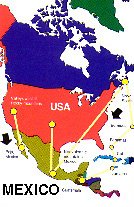
It is not likely that monarchs would have had programmed into them, from the beginning of creation, the exact route of their journey, but rather the capacity to establish such migration patterns and carry them out. The world has changed significantly since the great global Flood, and (see map, left) monarchs have clearly made adjustments to their patterns over time. This requires an even greater level of design sophistication. Not only does the monarch have to have a built-in clock, almanac, and navigational computer, it has to have the programmed capacity to make and remake its own internal maps. In addition, somehow that learned information (for example which tree it came from) has to be passed to the next generation, who have never flown over that route before. In the light of all that is known today about the processes of inheritance, how that could possibly be is a major mystery.
 The
incredible journeying of monarch butterflies
The
incredible journeying of monarch butterflies
The monarch butterfly is the only insect known to migrate annually over major continental distances. There are two basic migrating groups on the North American continent. The Eastern population is based east of the Rockies; some 300 million of these butterflies migrate from as far north as northern Nova Scotia to about 13 sites covering 25 hectares (40 acres) in the Neovolcanic Mountains in Mexico (some 250–50 km [150–225 miles] west of Mexico City). Individual trees can harbour as many as 100,000 at a time, while sites can contain as many as 50 million!
Some are blown eastward to Bermuda. From here they fly nonstop to the Bahama Islands, and thence to Cuba, Jamaica, Hispaniola and Puerto Rico, and on to winter sites in Guatemala. The Western population live in valleys west of the Rocky Mountains, and winter in a number of sites stretching from Bodega Bay in northern California to Baja, Mexico. Little is known about the South American monarch migrations. There are monarchs in other parts of the world which do not migrate.
Designing navigation equipment to take men beyond the confines of this planet and safely back again took an enormous amount of intelligent effort. The fact that the monarch can do these unbelievable feats with such an amazingly miniaturized ‘control centre’ reveals a level of design engineering which demands an overwhelmingly great intelligence. The Bible indicates clearly who that intelligent Creator was—Jesus Christ, the eternal Word, (John 1:1–3) God the Son, ‘in whom are hid all the treasures of wisdom and knowledge’ (Colossians 2:3).
The same Bible makes it clear that at the return of Christ, those who now arrogantly scoff at and reject the Creator of the universe will be left with no excuse—no arguments, since to those who are not willfully blind, the evidence of this almighty power is everywhere. At that time ‘every knee shall bow’ to Him (Isaiah 45:23). Those who bend the knee now in repentance will receive His loving forgiveness—those who refuse to do so now will do it later, receiving His righteous judgment instead.
Footnotes
- See the author’s book From Darkness to Light to Flight: Monarch—the Miracle Butterfly.
- In fact, this has been recently confirmed by experiment. See A Sun compass in monarch butterflies, Nature 387:29, 1 May 1997.
- Scattered light is polarized; the direction of polarization enables the butterfly to determine the direction of the light source even if obscured by clouds.
- Ref. 1 gives many more details of this amazing insect’s migration and life cycle. See also F. Urquhart, The Monarch Butterfly: International Traveller, Nelson Hall, Chicago, 1987.

Support the creation/gospel message by donating or getting involved!

Answers in Genesis is an apologetics ministry, dedicated to helping Christians defend their faith and proclaim the good news of Jesus Christ.
- Customer Service 800.778.3390
- Available Monday–Friday | 9 AM–5 PM ET
- © 2026 Answers in Genesis