

Trilobite Technology
Incredible Lens Engineering in an “Early” Creature.
Originally published in Creation 21, no 1 (December 1998): 23.
Trilobites, described by Stephen Jay Gould as “everyone’s favourite invertebrate fossil,” are a class of marine arthropods which are often well preserved and of striking appearance.1,2 They are believed to be extinct.
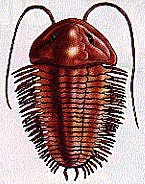
They are mostly between 10 and 50 mm long (3/8 to two inches) although a few species attained a length of 750 mm (2 1/2 feet). Trilobites are characterized by a ridged carapace, or shell, made of chitin, divided into three lobes which give the class its name.
While most trilobites had eyes, a number had none. A common form of trilobite eye consisted of an array of rods known as ommatidia, each of which pointed in a slightly different direction. The array was protected by a transparent membrane, or cornea. Such eyes are also found in insects and crustaceans.
However, within the family Phacopidae, there were trilobites with an eye of a fundamentally different nature, the aggregate or schizochroal eye.
Trilobites are mostly found in Cambrian rock,3 which evolutionists claim was laid down hundreds of millions of years ago. Most people mistakenly think that these were much simpler creatures than today’s. This is actually not true. The aggregate eye, for example, reveals remarkably precise design. The details in the technical section below show us that this trilobite eye, far from being “primitive,” was constructed on the basis of precise optical engineering principles which people only discovered a few centuries ago.
It is pointless to talk of “natural selection acting over millions of years” as the cause of this brilliant design. There is no record of indifferently designed lower lenses. More importantly, there is no need for the trilobite to have had a perfect eye, or even any eye at all. Many had no sight, but there is no evidence that they coped any less well.
Evolutionists claim that “design” in nature is only in response to need. However, from a creation perspective, design in organisms, though certainly related to functional need, also glorifies God and testifies to Him. Romans 1:20 (KJV) reminds us that “the invisible things of him from the creation of the world are clearly seen, being understood by the things that are made, even his eternal power and Godhead; so that they are without excuse.”
Technically speaking … the aggregate eye of the Phacopid Trilobite
The aggregate eye has a lens which consists of two parts. The upper lens is of oriented calcite (refractive index n=1.66) and the lower of chitin (refractive index n=1.53). The shape of the common boundary is described by a fourth-order equation.
Professor Levi-Setti, an authority on trilobites, states that with a calcite lens immersed in water (as would be the case for trilobites) it is impossible for the upper lens alone to function as required.4
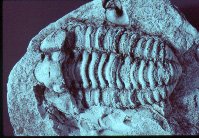
The lower lens is shaped to correct the ray pattern emerging from the calcite lens and to focus all rays on a common point.
A similarly shaped boundary for a glass lens in air was deduced by both Descartes5 and Huygens.6
In regard to the trilobite lens, Levi-Setti states:7
“There is in fact only one choice of indices for which the lens brings an incident parallel beam to a focus. This involves the upper lens being made of calcite (n=1.66) and the intralensar bowl being made of chitin (n=1.53).”
Dr Levi-Setti concluded:
“Trilobites had solved a very elegant physical problem and apparently knew about Fermat’s principle, Abbé’s sine law, Snell’s laws of refraction and the optics of birefringent crystals … .”8
Footnotes
- R. Prokop, Fossils. Hamlyn Colour Guide, Hamlyn, London, 1981.
- R. Levi-Setti, Trilobites: A Photographic Atlas, University of Chicago Press, Chicago, 1975.
- Trilobites are not officially documented as existing in rocks above the so-called Permian, although at least one is known from the Paluxy area in Texas, apparently having come from Cretaceous limestone (see Creation 14(4):49).
- R. Levi-Setti, Trilobites: A Photographic Atlas, University of Chicago Press, Chicago, 1975, p. 38.
- R. Descartes, La geometrie, oeuvres de Descartes, Vol. 6, ed. C. Adam and P. Tannery, Libraire Philosophique, Paris.
- C. Huygens, Treatise on Light, 1690. Translated by S.P. Thompson, University of Chicago Press, 1912.
- R. Prokop, Fossils. Hamlyn Colour Guide, Hamlyn, London, 1981.
- Ref. 4, p. 33.
Support the creation/gospel message by donating or getting involved!

Answers in Genesis is an apologetics ministry, dedicated to helping Christians defend their faith and proclaim the good news of Jesus Christ.
- Customer Service 800.778.3390
- Available Monday–Friday | 9 AM–5 PM ET
- © 2026 Answers in Genesis