

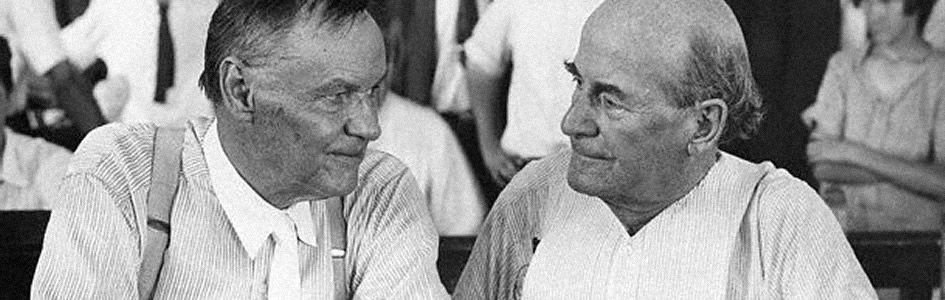
Photo taken of Clarence Darrow (left) and William Jennings Bryan (right) during the Scopes Trial in 1925.
The Scopes Trial … What’s the Big Deal?
For many people, the Rhea County Courthouse is just another interesting stop on their way through Tennessee.
For many people, the Rhea County Courthouse is just another interesting stop on their way through Tennessee. They are curious to visit the place where the Scopes trial took place 75 years ago. However, very few of the visitors—and not many of those who actually live in Dayton, Tennessee—realize the true impact and legacy left by the most famous American trial of the twentieth century.
First Some Background
When the anti-evolution Butler Act was passed in Tennessee in March 1925, the American Civil Liberties Union (ACLU) launched a campaign seeking someone to challenge this law that forbade the teaching of evolution in Tennessee’s public schools. George W. Rappleyea of Dayton read an ACLU ad and decided that the potential publicity generated by such a challenge would be a good way to attract businesses and industries to his town.
Although John Scopes was never actually sure he taught evolution . . . he volunteered to challenge the law.
Although John Scopes was never actually sure he taught evolution (he was a high-school coach who had substituted for the biology teacher during the last few weeks of the school year), he volunteered to challenge the law which made it “unlawful for any teacher in any of the . . . public schools of the state . . . to teach any theory that denies the story of the Divine Creation of man as taught in the Bible, and to teach instead that man has descended from a lower order of animals.” Scopes went to trial.
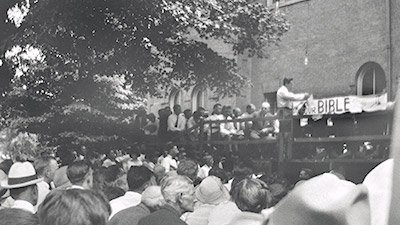
William Jennings Bryan was called in to assist the prosecution, while famed defense lawyer, Clarence Darrow, led the defense. The trial began on July 10, 1925 and lasted several days, amidst piano-“playing” monkeys and a carnival-type atmosphere. A team of scientists and even theologians traveled to Dayton to help the Scopes’ defense (although their testimony was not part of the trial, it is recorded in the transcripts) and proclaim that evolution was true and the law should therefore be struck down.
After Darrow questioned Bryan on the witness stand, and before Bryan could do the same to his counterpart, Darrow decided to have Scopes plead guilty in order to avoid being examined by Bryan on the stand. Scopes was fined $100. This conviction was later overturned on a technicality.
Now for the Lessons
Both evolutionists and creationists agree there are important lessons to be learned from the “Monkey Trial”.
Doug Linder, professor of law at the University of Missouri in Kansas City, stated recently in an interview posted on CNN:
The trial probably had its greatest effect in the success of Darrow in turning the trial into a national biology lesson through the prepared statements of his scientific experts, which were distributed to the press, and he succeeded in reversing momentum toward bans on teaching evolution.1
Ironically, the very arguments used in Darrow’s biology lesson to which Linder referred have virtually all been discredited and thrown out by evolutionists themselves. And therein lies one of the lessons Christians need to glean from this trial: the theologians who made their pronouncements in Dayton stated repeatedly that the Bible was only a human work and therefore Christians need to trust the scientists to tell them what has occurred in the past. However, as Ken Ham points out in his article, these church leaders had it the “wrong way round”. The compromising theologians of that day refused to accept God’s unchanging Word as their authority, and instead accepted the word of the scientists—opinions which have since been revised and updated, and often discarded completely.
The Scopes trial should be a “big deal” to Christians—a reminder that a proper defense of the faith must begin with God’s Word as the ultimate authority.
By the Way
Many believe the play Inherit the Wind to be a factual interpretation of the events of the Scopes trial. In no way is the play a documentary of the trial, and was actually not intended by its authors to be an accurate portrayal of the “Monkey Trial.” Ironically, the very humanist organizations seeking to educate the public by promoting the play are, in truth, endorsing a blatant misrepresentation of the facts. Dr. David Menton of AiG provides an analysis of Inherit the Wind.
Footnotes
- “Law Professor Doug Linder on the LEgacy of the Scopes Monkey Trial,” CNN, July 12, 2000, http://www.cnn.com/2000/LAW/07/transcripts/linder.scopestrial.fl.07.12/.
Support the creation/gospel message by donating or getting involved!

Answers in Genesis is an apologetics ministry, dedicated to helping Christians defend their faith and proclaim the good news of Jesus Christ.
- Customer Service 800.778.3390
- Available Monday–Friday | 9 AM–5 PM ET
- © 2026 Answers in Genesis