


What Was the Star of Bethlehem?
There have been many attempts to explain the Christmas Star scientifically, and three will be mentioned here.
Reprinted with permission from Astronomy and the Bible.
There have been many attempts to explain the Christmas Star scientifically, and three will be mentioned here. Some scholars think this “star” was a comet, an object traditionally connected with important events in history, such as the birth of kings. However, records of comet sightings do not match up with the Lord’s birth. For example, Halley’s Comet was present in 11 B.C., but the first Christmas took place around 5 to 7 B.C. Others believe that the Star of Bethlehem was a conjunction, or gathering of planets, in the night sky. Since planets orbit the sun at different speeds and distances, they occasionally seem to approach each other closely. However, multiple planets do not look like a single light source, as described in Scripture. Also, planetary alignments are rather frequent and therefore not that unusual. There was a conjunction of Jupiter and Saturn in 6 B.C., but an even closer gathering in 66. B.C., much too early! Finally, an exploding star, or supernova, has been proposed to explain the Christmas Star. Some stars are unstable and explode with a bright blaze. However, historical records do not indicate a supernova at the time of the Lord’s birth.
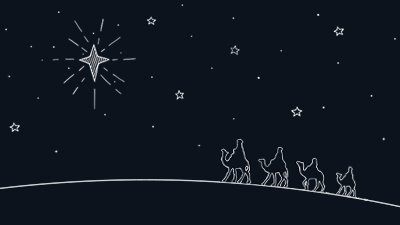
All three explanations for the Star of Bethlehem fall short of the nativity story as predicted in Numbers 24:17 and recorded in Matthew 2:1–12. Two details in Matthew are of special interest. First, the text implies that only the Magi saw the star. Comets, conjunctions, and exploding stars would be visible to everyone on Earth. Second, the star went before the Magi, and led them from Jerusalem to Bethlehem. This is a distance of about six miles, in a direction from north to south. However, not only does every natural object in the sky move from east to west due to the Earth’s rotation, but it is difficult to imagine how a natural light could lead the way to a particular house.
The Star of Bethlehem cannot be explained by science!
The conclusion is that the Star of Bethlehem cannot be explained by science! It was a temporary and supernatural light. After all, was not the first Christmas a time of miracles? God has often used special, heavenly lights to guide His people, such as the glory that filled the tabernacle (Exod. 40:34–38) and the temple (1 Kings 8:10) and that shone upon the apostle Paul (Acts 9:3). Such visible signs of God’s presence are known as the Shekinah Glory, or dwelling place of God. This special light is a visible manifestation of divine majesty. The great mystery of the first Christmas is not the origin of its special star. It is the question of why the Magi were chosen to follow the light to the Messiah, and why we are given the same invitation today.
Support the creation/gospel message by donating or getting involved!

Answers in Genesis is an apologetics ministry, dedicated to helping Christians defend their faith and proclaim the good news of Jesus Christ.
- Customer Service 800.778.3390
- Available Monday–Friday | 9 AM–5 PM ET
- © 2026 Answers in Genesis