

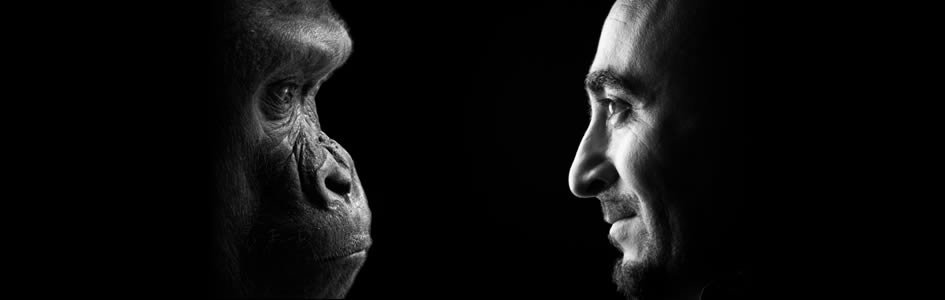
Chimp-Human Hybridization: Two of a Kind or Two Different Kinds?
There seems to be a never-ending stream of media reports that promote evolution. The latest is the provocative notion that there was hybridization between human and chimpanzee ancestors. This recent study by Patterson and colleagues1 has been plastered all over the news the last few days to once again reinforce the view that humans and chimpanzees shared a common ancestor. However, this time the issue is portrayed as “complex.”
The authors have done a very extensive study comparing the DNA sequences of humans, chimpanzees, gorillas, orangutans and macaques, and analyzed significantly more data than all previous studies of its type. However, the study does not really provide new evidence to prove chimps and humans came from a common ancestor, and the extent of its insight into evolution may be questionable. A great deal of work went into this study, and in critiquing the conclusion, I do not want to detract from the amount of effort involved.
Patterson and colleagues make the suggestion that chimps and humans began to diverge about 10 million years ago. Then, about 6 million years ago, they believe the two distinct populations merged to form a group of hybrids. They believe that fertile hybrid females then crossed back to one of the ancestral species, subsequently giving rise to distinct human and chimpanzee species.
Although the idea seems bizarre, the authors suggest a number of reasons for reaching this conclusion. First, they estimate a large percentage of genetic loci where humans match gorillas more closely than chimpanzees, as well as those where chimpanzees match gorillas more closely than humans. Yes, you read that correctly. Humans and chimpanzees are supposed to be the most-closely related, as some have even suggested that they should be considered the same genus.2 However, at 18–29% of the genetic loci, humans and gorillas or chimpanzee and gorillas were more closely matched than humans and chimpanzees. Perhaps we should say that human and chimp DNA is exactly the same … except where it is different!
A second reason is that human and chimpanzee X chromosomes are much more similar than the other chromosomes. A third reason for suggesting the separation and subsequent hybridization is the fact that molecular clock analysis of different segments of DNA yield different divergence dates. Some of the DNA had a divergence date of ~10 million years ago, while the rest was dated at ~6 million. Further, divergence dates based on molecular data typically yield ages that are much, much earlier than those obtained with fossils. Thus, they conclude that genetic divergence precedes species divergence.
Additionally, they cite Toumai (Sahelanthropus) as additional evidence that supports their hypothesis. Sahelanthropus is believed to have human-like characteristics such as bipedal locomotion and dentition; perhaps it represents one of the early intermediates prior to hybridization. This ignores the controversy regarding this specimen, since some scientists have suggested it is a female ape. Some of the so-called “human-like” characteristics are also those that distinguish female and male apes. In addition, the bipedality has not been firmly established since there is a lack of post-cranial remains, and the skull itself has been badly damaged during fossilization.
The Patterson study has come under criticism from an evolutionist perspective.
The large number of sequences where humans and gorillas match and differ from the chimpanzee (and chimpanzees and gorillas match but differ from humans) is unexpected from a Darwinian standpoint. Since similar DNA sequences are thought to result from common ancestry, the assumption of the hybridization event is necessary to maintain common ancestry in spite of the divergent and conflicting sequences.
The Patterson study has come under criticism from an evolutionist perspective.3 Anthropologist John Hawks noted several potential problems with the hybridization hypothesis. In particular, the effective population size is a factor that affects genetic diversity and thus apparent divergence dates and could explain the data better than hybridization. Further, many other studies assumed or determined a chimp-human divergence date of around 6 million years ago long before this one. The contribution of this work is only to try to shed light on what happened before the previously estimated chimp/human divergence date.
The creationist connection
Hawks also criticized the study for how he thought creationists would handle it:
Here is what I think is the worst part. It is sad that I have to care about it, but this idea of human-chimpanzee hybridization should be very appealing to creationists … . I think the most likely result is that the rest of us scientists will just ignore or move past this specific hypothesis. And it is possible that further evidence will emerge to make it seem more likely. But creationists will now cite Eric Lander in support of the idea that hominid fossils are not transitional between apes and humans, but instead are hybrids of apes and humans. [emphasis in original]
While it is interesting that evolutionists would be concerned about how creationists would handle a paper such as this, his fear is misplaced. Actually, this is what Patterson and colleagues have suggested. Credible creation scientists that I know believe that humans and apes are separate kinds. As far as the fossil hominids go, they are either full-fledged humans like the Neandertals, or extinct apes like “Lucy” the australopithecine. Creationists have no reason to invoke an outlandish hypothesis like human/ape hybrids to explain the fossil record. It is the evolutionist who must resort to this idea to defend common ancestry in light of the confusing molecular data.
Importantly, the Patterson study does not detract from creationist challenges to chimp/human ancestry. Indeed, its primary objective appears to be to explain the fact that there are large portions of both the human and chimpanzee chromosomes that match gorillas better than each other. There remain many significant differences between human and chimpanzee DNA that were not even addressed by Patterson and colleagues. Among others, these include:4
- alleged fusion of two chromosomes to make human chromosome 2
- differences in telomere length between humans and apes
- chromosomal inversions
- differences in repetitive DNA elements
In conclusion, the Patterson study does little to explain the molecular data. Even from an evolutionary perspective there are more plausible alternative explanations than hybridization events. Nor does the study significantly challenge the creationist assertion that humans and chimpanzees never shared a common ancestor. It does, however, demonstrate the incredible lengths to which evolutionists must go to rebuff the truth: humans and chimpanzees are now, and have always been, two different kinds.



Footnotes
- Patterson, N., Richter, D.J., Gnerre, S., Lander, E.S. and Reich, D, Genetic evidence for complex speciation of humans and chimpanzees, Nature 441:315–321, 2006.
- Wildman, D.E., Uddin, M., Liu, G., Grossman, L.I. and Goodman, M., Implications of natural selection in shaping 99.4% nonsynonymous DNA identity between humans and chimpanzees: Enlarging genus Homo, Proc. Natl. Acad. Sci. USA 100(12):7181–7188, 2003.
- Hawks, J., The dawn chumans, www.johnhawks.net/weblog/reviews/genomics/divergence/dawn_chumans_patterson_2006.html, May 17, 2006.
- DeWitt, D.A., Chimp Genome Sequence Very Different from Man, September 5, 2005.
DeWitt, D.A., The Differences Make the Difference, March 20, 2006.
Support the creation/gospel message by donating or getting involved!

Answers in Genesis is an apologetics ministry, dedicated to helping Christians defend their faith and proclaim the good news of Jesus Christ.
- Customer Service 800.778.3390
- Available Monday–Friday | 9 AM–5 PM ET
- © 2026 Answers in Genesis