
Islands’ Weeds Don’t Support Evolution
on
June 1, 1996
Originally published in Creation 18, no 3 (June 1996): 12-13.
The clear evidence is that the weed research on Canada's islands points not to evolution, but to creation.
Any claim that evolutionary biologists have witnessed evolution in action is of interest to creationists. We recently talked about a claim by Dr Jared Diamond (Creation magazine, Vol. 16 No. 3, p. 41) that evolution has been observed. He cited the changes in peppered moths and insecticide resistance in mosquitos. We showed (from the work of other evolutionists around 20 years before) that these were definitely not cases in which evolution was happening.
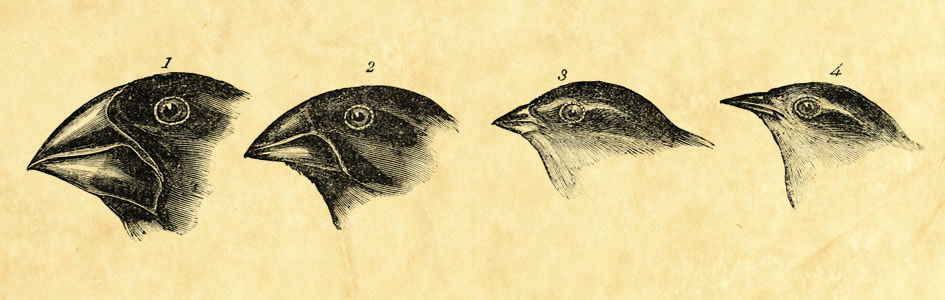
Evolutionists of course claim large-scale evolution has occurred (non-life turned into life, then the first 'simple' life evolved all the way up to people). Yet all they point to as proof of this are minor changes — such as varying beaks in finches, or different colours in moths. Also, evolution is supposed to be a process generating lots of new genetic information. Yet the examples they cite invariably turn out to show no such thing. So we were interested to read in the scientific journal Nature, 14 March 1996, page 103, in another item by Dr Diamond, that a case of rapid evolution had allegedly been observed off Canada's Pacific coast.
Researchers Martin Cody and Jacob Overton had reported 'direct detection of both rapid evolutionary change and the "founder effect" in populations of wild plants. (The founder effect is the phenomenon whereby new colonies of a species may become instantly distinct from the parent population, as a result of their few founding individuals being an atypical sample.)'
But is this a genuine case of evolution? Was new information added to the plants' DNA, so that something truly new could be said to have arisen? The answer again is a resounding 'no'.
In essence, what happened was this:
The researchers studied the 'loss of dispersal ability' of plants confined to islands. Many species that are found only on remote islands seem to lack any way of reaching those islands in the first place. So why are they different from similar plants on the mainland?
Cody and Overton did a detailed study over 10 years of some weeds whose seeds were dispersed by the wind (in the way we see dandelion fluff distributed by the wind). The design features in these airborne seeds show some natural variation; some of the plants produce airborne seeds which are able to travel further than others.
They found that in only a few generations, these plants on the island produced seeds less able to travel far and wide (on average) than those plants on the mainland from which they had descended. This was said to be 'an especially clear and simple example of evolution through natural selection, witnessed historically'.
While this may be a clear example of natural selection, it must be realized that natural selection is not evolution (in the sense in which evolution is normally understood) since by itself it cannot generate anything new.
Natural selection does not produce any truly novel characteristics.
Natural selection does not produce any truly novel characteristics, such as feathers on reptiles to turn them into birds. It simply operates on characteristics that are already present in the genetic code, like varying shapes, colours, or sizes.
This is what happened with the weedy plants on Canada's islands. On a small island, highly mobile seeds would be likely to travel beyond the boundaries of the land. Or to put it another way, plants with genes for less mobile seeds are more likely to establish their offspring on that island.
The diagram makes it clear how this effect can happen. It is an expression of the variation which was there all along, and has nothing to do with the imagined process of how a one-celled creature could turn into peacocks, pears, and people.
In fact, rather than proving evolution in the way Charles Darwin thought it did, natural selection is really a wonderful example of the creationists' principle of conservation in operation. The genetic system maintains its identity as a specific kind, while the distribution of characteristics within that kind is rearranged to allow the plant or animal population to survive changes more readily in the environment.
Despite the fact that Dr Jared Diamond opens his article with a sideswipe at creationists, the clear evidence is that the weed research on Canada's islands points not to evolution, but to creation.
How selection might operate on weed species 'x' ('x-weeds') with airborne seeds
 = = |
x-weeds with genes coding for mostly far-ranging seeds |
 = = |
x-weeds with genes coding for mostly short-range seeds |
 = = |
x-weeds with genes coding for both, producing mostly medium-range seeds but also occasional seeds of both short- and long-range. |
|
STEP 1 — before the x-weeds colonize the island
|
STEP 4 |
||||
|
STEP 2 |
STEP 5 |
||||
|
STEP 3 |
|||||
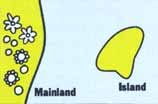
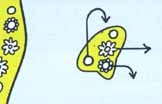
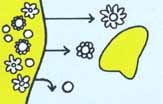
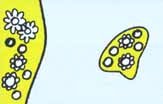
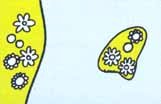
This is not evolution — all the genes were there in the first place.
Support the creation/gospel message by donating or getting involved!

Answers in Genesis is an apologetics ministry, dedicated to helping Christians defend their faith and proclaim the good news of Jesus Christ.
- Customer Service 800.778.3390
- Available Monday–Friday | 9 AM–5 PM ET
- © 2026 Answers in Genesis