

Chapter 13
George T. Javor, Biochemistry
If we don’t understand how a world like ours could be created in six days, we need to ask how a world like ours could be created at all.
is Professor of Biochemistry, School of Medicine, Loma Linda University, in Loma Linda, California. He holds a B.S. in chemistry from Brown University, a Ph.D. in biochemistry from Columbia University, New York, and completed post-doctoral studies at Rockefeller University. Dr. Javor has published over 40 technical papers and abstracts in the area of biochemistry and a similar number of articles on science-Bible topics.
I am a practicing scientist and a believer in a six-day creation. It is probably safe to assume that the majority of contemporary scientists do not accept the authenticity of the creation account of Genesis 1 and 2. The reason for this is not hard to guess. There is no evidence that the writer of the book of Genesis was aware of the existence of gravitational force, of atoms, neutrons, protons and electrons, of the mass of the earth, or of the dimensions of the solar system. In other words, from a modern perspective, the creation account of the book of Genesis was written in a background of scientific ignorance.
So let us look at the world from our modern perspective, and ask whether it is reasonable to suppose that it came into being in six days. We now know that ours is an immensely complex world. Its inanimate components, the gigantic masses of land, water and air, are in a continuous flux, and there is yet much to learn about their dynamics. This is painfully clear when we see how inadequate are the efforts to forecast the weather, hurricanes or earthquakes.
We notice the springs in the mountains give rise to rivers, which flow into lakes and oceans. The waters of the oceans then return into the mountains by means of rain and snow and through underground paths. The cycling of water bathes the earth’s surface and is indispensable for the existence of life. So are the cycles of the elements carbon, nitrogen and sulfur through the biosphere.
The cycle theme in fact is everywhere from the movement of the electrons around the atomic nucleus to the rotation of the earth around the sun. Cycles do not have beginnings or ends. In order to bring them into existence, the forces responsible for the cycles have to be balanced, and if there are multiple steps required for the completion of a cycle, all of the components of the cycle have to be in place. Cycles speak of organization, of design, of rapid implementation and of a designer.
The complexity of the animate world is orders of magnitude greater than that of inanimate nature. The earth is covered with multitudes of different forms of life. With the exception of some microorganisms, all life-forms are running on solar power, either directly or indirectly. Plants capture the sun’s light energy by their green solar panels and package it into stable chemical entities such as carbohydrates. These sugars become the energy source for all organisms that are “photosynthetically challenged.”
Having photosynthetic capacity does not render plants completely self-sufficient. In the absence of soil microorganisms that convert the air’s nitrogen gas into useful nitrates, plants cannot grow. The existence of plants completely depends on nitrogen-fixing microbes. Other soil microorganisms degrade dead organic matter, thereby recycling the precious elements of carbon, nitrogen, sulfur and phosphorus.
Photosynthesis makes oxygen available for all nonbacterial organisms. Oxygen, of course, is used by the organisms to burn carbohydrates. This is done at such slow rates that the sun’s energy is not lost as heat, but is trapped in the form of the universal “currency” of energy, adenosine triphosphate or ATP. One of the products of this slow combustion, carbon dioxide, is not lost but used by plants for their growth. By these means, every living organism is linked into a giant solar-energy-utilizing network.
What we have here is a seamless integration of earth’s rotation around the sun with the phenomenon of life on our planet. Is it far-fetched to suggest that the Creator of the sun and the earth is also the engineer who designed the solar-powered living organisms?
Recent advances in biology permit us to ask whether it is still reasonable to suppose that living organisms evolved on a hypothetical primordial earth from mixes of organic chemicals.
Recent advances in biology permit us to ask whether it is still reasonable to suppose that living organisms evolved on a hypothetical primordial earth from mixes of organic chemicals. At the time when the modern versions of these theories were first entertained, in the 1920s, so little was known about the biochemical realities that undergird living organisms that such proposals seemed reasonable. But now we know that even the simplest of living cells, bacteria (that are not parasitic), must contain thousands of complex structural and catalytic proteins, a variety of nucleic acids, hundreds of small bio-molecules, all in a dynamic nonequilibrium steady state.
Within live cells, we see numerous series of interconnected chemical conversions (“pathways”) that are functioning uninterrupted. Their continuous activities are due to steady supplies of starting material and the ongoing utilization of end products. The recycling of waste to biosynthetic precursors completes the cycling of matter through living systems.
The absence of any component of these complex series of chemical changes will cause defective operation or even death to the cell. Is it reasonable, then, to suppose that when living cells were first brought into existence, all of their components must have been present and functioning? If this is so, then living cells had to be made rapidly.
The same suggestion may be made for all of the components of the ecological system, where mutual support and interdependence exist. It is sensible to suppose that these were created simultaneously. (To be sure, the picture is muddied by predation, which was not part of the original created order.)
If we had complete knowledge of every aspect of our physical world, both animate and inanimate, we could calculate the number of inventions that are represented in them. When we assert that our world has been created by a Creator, we imply the existence of a mind that not only invented nature but brought it all into existence. The greatness of such a God cannot be exaggerated.
If we don’t understand how a world like ours could be created in six days, we need to ask how a world like ours could be created at all. We will have to admit that we just do not know. The difference between a late 20th-century believer in the Creator God and one living in 1500 BC, at the time of Moses, boils down to the fact that now we have a better perspective on the greatness of the Lord.
For the believer who is also a scientist, the words of the Bible: “For in six days the Lord made the heaven and the earth, the sea, and all that is
” (Exod. 20:11) still make wonderful sense.
In Six Days
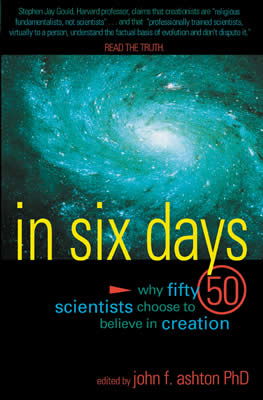
Can any scientist with a Ph.D. believe in the idea of a literal six-day creation? In Six Days answers this provocative question with 50 informative essays by scientists who say “Yes!”
Read Online Buy Book
Master Books has graciously granted AiG permission to publish selected chapters of this book online. To purchase a copy please visit our online store.
Support the creation/gospel message by donating or getting involved!

Answers in Genesis is an apologetics ministry, dedicated to helping Christians defend their faith and proclaim the good news of Jesus Christ.
- Customer Service 800.778.3390
- Available Monday–Friday | 9 AM–5 PM ET
- © 2026 Answers in Genesis