


Chapter 42
Geoff Downes, Forestry Research
Even to be able to begin to have confidence in my ability to reason, I have to start with a revelation from the One who made me.
is Senior Research Scientist with the Commonwealth Scientific and Industrial Research Organisation (CSIRO), Division of Forestry and Forest Products, in Australia. He holds a B.S. (hons) first class from Monash University, a Ph.D. in tree physiology from the University of Melbourne, and spent a year as a post-doctoral fellow at the University of Aberdeen, Scotland. At CSIRO, Dr. Downes researches climatic and environmental effects on wood formation.
I received the last four years of my secondary education at a leading church school in Melbourne, Australia. In year 11, I took a course entitled Biblical Studies. It was a small class taught by our school chaplain, and started with a study of Genesis. We were taught, without equivocation, that Genesis was a mythical account and did not represent real history. I was surprised but, as I had not really considered the issue in any depth, not particularly shocked. Unlike most of my classmates, I was a Christian at the time, having been made to confront the reality of God and His claim over my life when I was 13, as God brought me to that point of personal decision and commitment.
In 1980 I commenced a science degree at Monash University. Almost immediately the discomfort with my theistic evolutionary understanding began to make itself felt. Looking back, I would describe myself as a reluctant theistic evolutionist—a “theistic evolutionist” because that was how I had been trained; “reluctant” because it seemed so inconsistent to accept the Bible where it taught the simple Christian gospel, but reject that part on which the whole Christian position was founded. I knew that if I were challenged about my faith, this inability to confidently affirm the historical truth of the Bible would ultimately undermine my own faith. I would be found to be inconsistent in my belief. If I couldn’t believe the first book, what was my basis for believing the rest? In several discussions I had with others at this time, I came to the conclusion that it was not an effective form of evangelism to try to defend the Christian faith by argument. Essentially what I wanted was a worldview that was as consistent as possible with the world around me. I suppose that is the ultimate aim of any philosophy. The problem was that I had not been trained to think biblically. Although I had attended a church school, been involved in the church for most of my life, and attended Sunday school, I still had not been taught to think from a Christian worldview.
The laws of nature, in a closed system, always behaved this way.
In May 1980 I was sitting in a physical chemistry lecture. The lecturer was expounding the law of entropy. I can still remember the impact on me as what he was saying sank in. He was teaching us that the universe as a whole was proceeding from a more ordered state to a less ordered state. The laws of nature, in a closed system, always behaved this way. Naturally, I extrapolated back in time to the point when the universe began, the time of maximum order. I reasoned that if, in a closed system, the natural laws always increased the entropy of the whole, then ipso facto, unknown natural or supernatural laws were required to increase order.
What that lecture did was show me that at some points scientists are forced to be inconsistent. That is, they don’t know everything and are sometimes forced to hold theories in tension against the scientific evidence if they are going to hold to their belief systems. This lecturer was teaching us that natural law cannot explain how the universe as a whole can increase in order. Therefore, science cannot explain how this order originated. However, he also (I assumed) believed in evolution. I had never been taught that there were aspects of evolution that scientists could not explain. I thought that if I held to a belief in special creation, as explained in Genesis, then I was holding to a faith position, whereas scientists had evidence to support their view. This lecture helped me to realize that if scientists can’t explain all the evidence for evolution, perhaps I don’t need to have all the answers for a creationist position either.
Up until that day, my thinking was totally humanistic in that it started with the presupposition that I had the ability to reason things out logically. I had accepted the evolutionary worldview and, consequently, its presuppositions. That worldview rejected any role of revelation as a foundation for making sense of the world around me.
That day I stepped outside of my evolutionary, long-age mind-set, started going to other lectures, and endeavored to evaluate the evidence from both viewpoints. What I found was that the overwhelming majority of the scientific evidence we were taught bore no direct relation to either creation or evolution. The evidence that was presented within an evolutionary framework could equally well be reinterpreted within a creationist framework. As a result of that lecture, I chose to become a young-earth creationist. I chose to accept the Bible as the basis for all my thinking, and understand Genesis in the plain sense in which it was written. I could not explain all the things that I observed in nature within that framework, and I still cannot. But I knew that, if these lecturers could be inconsistent in the sense that they were not able to make the evolutionary framework fit the evidence at every point, then I could also hold in “tension” those areas of science that I could not explain within a creationist framework. My understanding of the creationist perspective became steadily stronger in its ability to accommodate and explain the real scientific evidence.
In 1984 I commenced a Ph.D. degree in tree physiology. Increasingly, I wonder at how anyone can look at the complexity of a living organism and believe that it arose by natural processes. The whole of the biological sciences leads to the conclusion that a Creator was necessary. That anyone can claim that science supports an evolutionary view decries belief. The complexity of not just living organisms but the communities within which they exist cannot be explained satisfactorily without the conclusion that there is a Creator.
Often I hear the argument that science cannot allow the presupposition or conclusion that a Creator exists. The moment you do, you supposedly step outside the realm of science. This is not so.
A large part of my research effort in forestry is trying to separate cause and effect. The vascular cambium is not a tissue that is readily amenable to traditional reductionist approaches in attempting to understand how it functions. Often our data sets contain artifacts that arise simply because we are measuring or observing a tree or forest. One of the fundamental activities we have to undertake when analyzing data is to try to determine where the data is influenced by our measurements and not by processes that occur naturally. That is, we are looking for “events” that cannot be attributed to nature but result from our “intelligent” involvement. The whole area of forensic science is focused on this aspect.
Consider finding a dead body in the park. Did the person die from natural causes, or was some other factor involved? If you find a knife in the back, then it is logical to assume that some outside intelligence was involved. However, if you start by assuming that the death occurred from natural causes, then you can never arrive at the correct conclusion. It is not a question of science, but the foundational assumptions you take to the data.
Over the past 15 years of research experience, my views have only become stronger. I have come to realize that evolution is a religious view founded on the assumption that we can discern truth by using the abilities of our mind to reason and think logically through the evidence perceived by our five senses. However, if we pursue that reasoning, we ultimately arrive at the conclusion that we have no logical basis for believing that we can reason logically. We cannot prove that our thought processes are not just random chemical reactions occurring within our brains. We cannot prove ultimately that we exist. Descartes was wrong when he said, “I think, therefore I am.” The decision to trust our ability to reason is a faith step. The theory of evolution is founded on this step of faith. However, even to be able to begin to have confidence in my ability to reason, I have to start with a revelation from the One who made me.
As C.S. Lewis stated, “I grew up believing in this (evolution) Myth and I have felt—I still feel—its almost perfect grandeur. Let no one say we are an unimaginative age: neither the Greeks nor the Norsemen ever invented a better story. But the Myth asks me to believe that reason is simply the unforeseen and unintended by-product of a mindless process at one stage of its endless and aimless becoming. The content of the Myth thus knocks from under me the only ground on which I could possibly believe the Myth to be true. If my own mind is a product of the irrational, how shall I trust my mind when it tells me about evolution?”1
In Six Days
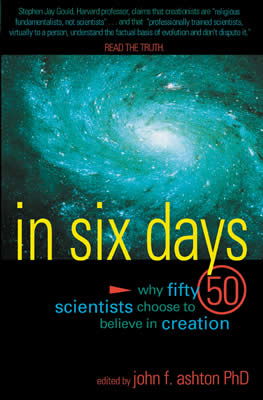
Can any scientist with a Ph.D. believe in the idea of a literal six-day creation? In Six Days answers this provocative question with 50 informative essays by scientists who say “Yes!”
Read Online Buy Book
Master Books has graciously granted AiG permission to publish selected chapters of this book online. To purchase a copy please visit our online store.
Footnotes
- C.S. Lewis, Christian Reflections, Wm. B. Eerdmans Pub. Co., Grand Rapids, MI, p. 89, 1975.
Support the creation/gospel message by donating or getting involved!

Answers in Genesis is an apologetics ministry, dedicated to helping Christians defend their faith and proclaim the good news of Jesus Christ.
- Customer Service 800.778.3390
- Available Monday–Friday | 9 AM–5 PM ET
- © 2026 Answers in Genesis