


Chapter 32
Robert H. Eckel, Medical Research
When examining the evidence available for either assertion, it becomes important to evaluate critically the precision and scientific accuracy of the methods used in the analysis.
is professor of medicine, and of physiology and biophysics, and program director, General Clinical Research Center, at the University of Colorado Health Sciences Center. He holds a B.S. cum laude in bacteriology, University of Cincinnati, and an M.D. from the University of Cincinnati College of Medicine. Dr. Eckel has published more than 80 research papers, 17 book chapters and received 20 research awards. He is a reviewer for 50 medical journals, a member of the American Society for Clinical Investigation and The Association of American Physicians, and chairman, Nutrition Committee, American Heart Association.
Several years ago I was contacted by a high school student who had chosen to allow his precocious knowledge of and commitment to creation science to take on the local board of education. The issue before him was how the science of the origins of life on earth was being taught (and not taught) in the classroom. As a scientist and professing six-day creationist and member of the technical advisory board of the Institute for Creation Research, I was presumably in a position to provide academic wisdom about the issue before him. Yet, I was amazed that the scientific acumen he had already assimilated was incredibly advanced for a 16-year-old, leaving me with little to add but a bit of advice.
The positions of concern and criticism that this young man had taken were that biologic origins were being taught as fact, not theory. This was true for both textbook and teacher. The student’s response by faith was that the origins of life were not a consequence of evolution, but a result of the sovereign and undeniable will of God. Although his position and defense of the Bible were clear, I perceived more than an effort to open the minds of the world around him; there was also an evangelistic hope that the message of creation might ultimately prove to be a vehicle to seed and reap lost souls.
Creation in six days is not an intellectual argument to be won by in-depth and repetitive examinations of the scientific evidence available.
The advice to follow may have been anything but profound, but represented a position as a scientist and six-day creationist believer that rests only in part on the evidence available. Creation in six days is not an intellectual argument to be won by in-depth and repetitive examinations of the scientific evidence available. The same data are available to both evolutionists and creationists. The issue scientifically is a single experiment, never to be repeated, with two basic theories to be considered. And in the case of the origins of life on earth, the hypothesis has followed the experiment rather than preceded it.
Evolutionists claim that biologic life began as atoms in a primordial soup. Subsequently molecules, organelles, cells, and ultimately multicellular organisms would develop over billions of years. Numerous lines of evidence from the fossil record, based mostly on isotopic dating, are repeatedly used to support this position. Nevertheless, the same fossil record has been used by six-day creationists; however, because of perceived flaws in the use of isotopic dating to determine the timing of events, six-day creationists use fossils to support a young earth.
In science, hypotheses typically are developed a priori and are examined subsequently by the use of scientific methods previously validated and accepted by most, if not all, experts in the given field of endeavor. With the assumption that the experimental design is appropriate to address the hypothesis to be tested, a series of observations is gathered to either support or refute the hypothesis. In most areas of science, observations are made at least several times by a single scientist, which are then repeated and confirmed by other scientists prior to accepting the “truth” of the hypothesis being tested. Moreover, it is often difficult, if not impossible, to substantiate conclusions by retrospective examination of data. For “origins” where at best the data are insufficient, this is particularly true. Thus, with evolution/creation, a scientific impasse exists which historically, presently, or forever has, does, and will create uncertainty in interpretation. How then should this student have proceeded?
The unbelieving world does not heed the things of the Lord, nor was it intended for them to do so because they are spiritually perceived (1 Cor. 1:18–29). Therefore, any argument to support a six-day creation (or any other view of creation for that matter) that is presented on the basis of faith is perceived flawed and labelled as religion, not science, by evolutionists. Thus, the position of the apologist needs to be scientific and sufficiently well developed academically so that the interchange of information can be implemented in the world’s terms. After the discussion begins, it is important to establish the position that the origins of life on earth was an “experiment” carried out only once in history, never to be repeated, and the proof of either position will never be substantiated.
When examining the evidence available for either assertion, it becomes important to evaluate critically the precision and scientific accuracy of the methods used in the analysis. Here the evolutionists’ acceptance of the tools utilized becomes questionable. Isotopic dating makes many assumptions that will remain unproven, for example, the linearity of isotopic decay over time. Yet, when experiments are carried out in their own laboratories, all scientists (evolutionists and six-day creationists alike) require a standard of validation for the methods used that are proven or at least well defended scientifically. It is amazing to consider how incomplete evolutionists have been in applying scientific rigor to the methods they have used to retrospectively analyze data that deals with “origins.” This is nothing but an act of blind faith on their behalf. Nevertheless, six-day creationist believers must remain objective in their approach to the data.
In the end, this student’s objection to the method utilized by the local school system to educate about “origins” reached a public forum in the county in which he resided. Although support for both positions was articulated by citizens, the majority of professionals who spoke up claimed evolution to be a fact. Thus, it was no surprise that the final decision was to continue as before, with the creationist position left out of the classroom. Nevertheless, the issue of “origins” is not a battle for us to win, but the life of the Lord Jesus Christ to be seen (Phil. 1:21). A well-informed, spirit-led believer is in the best position for this to occur.
In Six Days
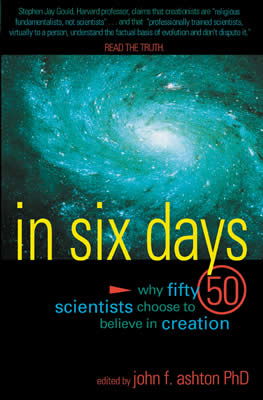
Can any scientist with a Ph.D. believe in the idea of a literal six-day creation? In Six Days answers this provocative question with 50 informative essays by scientists who say “Yes!”
Read Online Buy Book
Master Books has graciously granted AiG permission to publish selected chapters of this book online. To purchase a copy please visit our online store.

Support the creation/gospel message by donating or getting involved!

Answers in Genesis is an apologetics ministry, dedicated to helping Christians defend their faith and proclaim the good news of Jesus Christ.
- Customer Service 800.778.3390
- Available Monday–Friday | 9 AM–5 PM ET
- © 2026 Answers in Genesis