


Chapter 1
What Is Science?
by
Roger Patterson
on
February 22, 2007
; last featured
July 29, 2014
Republished with permission and featured in
Evolution Exposed: Biology
Also available in Deutsch
Even if all the data point to an intelligent designer, such an hypothesis is excluded from science because it is not naturalistic.
—Dr. Scott Todd, Kansas State University, Nature 401(6752):423, Sept. 30, 1999
What You Will Learn
Many people do not realize that science was actually developed in Christian Europe by men who assumed that God created an orderly universe. If the universe is a product of random chance or a group of gods that interfere in the universe, there is really no reason to expect order in nature. Many of the founders of the principle scientific fields, such as Bacon, Galileo, Kepler, and Newton, were believers in a recently created earth. The idea that science cannot accept a creationist perspective is a denial of scientific history.
To help us understand that science has practical limits, it is useful to divide science into two different areas: operational science and historical (origins) science. Operational science deals with testing and verifying ideas in the present and leads to the production of useful products like computers, cars, and satellites. Historical (origins) science involves interpreting evidence from the past and includes the models of evolution and special creation. Recognizing that everyone has presuppositions that shape the way they interpret the evidence is an important step in realizing that historical science is not equal to operational science. Because no one was there to witness the past (except God), we must interpret it based on a set of starting assumptions. Creationists and evolutionists have the same evidence; they just interpret it within a different framework. Evolution denies the role of God in the universe, and creation accepts His eyewitness account—the Bible—as the foundation for arriving at a correct understanding of the universe.
What Your Textbook Says
| Evolutionary Concept | Glencoe | PH-Campbell | PH-Miller | Holt | Articles |
|---|---|---|---|---|---|
| It is not necessary to distinguish between historical and operational science. | 11–23, 1060– 1061 | 19, 299 | 3–14 | 14– 20 | 1:1, 1:2, 3:1 |
| Observability, testability, repeatability, and falsifiability are the hallmarks of the scientific method. | 11–23 | 27, 37–38, 305 | 10, 14, 369, T537 | 19 | 1:1, 1:2, 1:3 |
| There are some questions science cannot answer. | 21–22 | 38 | 5–6 | — | 1:1, 1:3 |
| Questions about behavior can be answered by asking “why” questions. | — | 51, 54 | T870 | 824 | 1:1, 1:3 |
| Evolution was not observed, but we can still understand how it happened. | 396–397 | 51, 54 | 410 | — | 1:2, 1:3, 3:4 |
| Biblical creation is religion, and evolution is science. | — | — | 3 | 277 | 1:1, 1:2, 1:3 |
Note: Page numbers preceded by “T” indicate items from the teacher notes found in the margins of the Teacher’s Edition.
What We Really Know
If an idea is not testable, repeatable, observable, and falsifiable, it is not considered scientific.
In its original form science simply meant “knowledge.” When someone says today that they work in the field of science, a different picture often comes to mind. Science, in the view of an outspoken part of the scientific community, is the systematic method of gaining knowledge about the universe by allowing only naturalistic or materialistic explanations and causes. The quote on page 19 reflects this attitude. Science in this sense automatically rules out God and the possibility that He created the universe because supernatural claims, it is asserted, cannot be tested and repeated. If an idea is not testable, repeatable, observable, and falsifiable, it is not considered scientific. The denial of supernatural events limits the depth of understanding that science can have and the types of questions science can ask. We may define naturalism and materialism as:
Naturalism: a belief denying that an event or object has a supernatural significance; specifically, the doctrine that scientific laws are adequate to account for all phenomena.
Materialism: a belief claiming that physical matter is the only or fundamental reality and that all organisms, processes, and phenomena can be explained as manifestations or interactions of matter.
The problem with the above definition of science is that, even though naturalistic science claims to be neutral and unbiased, it starts with a bias. The quote from Dr. Todd on page 19 demonstrates that bias: only matter and energy exist and all explanations and causes must be directly related to the laws that matter and energy follow. Even if the amazingly intricate structure of flagella in bacteria appears so complex that it must have a designer, naturalistic science cannot accept that idea because this idea falls outside the realm of naturalism/materialism. Many scientists have claimed that allowing supernatural explanations into our understanding of the universe would cause us to stop looking for answers and just declare, “God wanted to do it that way.” This is, of course, false.
The ability to study the world around us is only reasonable because there is a Lawgiver who established the laws of nature. Most people do not realize that modern science was founded by men who believed that nature can be studied because it follows the laws given to it by the Lawgiver. Johannes Kepler, one of the founders of astronomy, said that science was “thinking God’s thoughts after Him.” Many founders of scientific disciplines, such as Bacon, Newton, Kepler, Galileo, Pascal, Boyle, Dalton, Linnaeus, Mendel, Maxwell, and Kelvin were Bible-believing Christians. As a matter of fact, the most discerning historians and philosophers of science have recognized that the very existence of modern science had its origins in a culture at least nominally committed to a biblical worldview. (See www.answersingenesis.org/go/bios.)
Science has been hijacked by those with a materialistic worldview and exalted as the ultimate means of obtaining knowledge about the world.
What, then, should Christians think of science? Science has been hijacked by those with a materialistic worldview and exalted as the ultimate means of obtaining knowledge about the world. Proverbs tells us that the fear of God, not science, is the beginning of knowledge. In a biblical worldview, scientific observations are interpreted in light of the truth that is found in the Bible. If conclusions contradict the truth revealed in Scripture, the conclusions are rejected. The same thing happens in naturalistic science. Any conclusion that does not have a naturalistic explanation is rejected.
The words creation and evolution can be used in many different ways. Evolution will be used in this book to describe the naturalistic process that is alleged to have turned molecules into man over billions of years. As creation is used through out this book, it is intended to describe the supernatural acts of God who created the universe and everything in it in six, approximately 24-hour days, about 6,000 years ago. This perspective is often referred to as young-earth creationism. The true history of the universe is revealed to us from God’s eyewitness perspective in the Bible. This history can be summarized as the 7 C’s of history: Creation of the universe, Corruption of the universe as a result of man’s sin, the judgment of mankind in the Catastrophe of Noah’s Flood, Confusion of languages at Babel, Christ coming to earth to live a righteous life and then to pay for our sins on the Cross, and the future Consummation when God creates the New Heaven and New Earth. This history serves as a foundation for interpreting evidence in the biblical creationist’s worldview.
Making a distinction between two types of scientific study helps us to understand the limitations of naturalistic presuppositions in science:

The examples of science used in the textbooks show only operational (observational) science. This type of science, which makes observations and repeated experiments in the present, allows us to produce technology that benefits mankind. Evolution does not fit within the definition of operational science and should be classified as historical (origins) science
Operational (Observational) Science: a systematic approach to understanding that uses observable, testable, repeatable, and falsifiable experimentation to understand how nature commonly behaves.
Operational science is the type of science that allows us to understand how DNA codes for proteins in cells. It is the type of science that has allowed us to cure and treat diseases, put a man on the moon, build satellites and telescopes, and make products that are useful to humans. Biblical creationists believe that God has created a universe that uses a set of natural laws that operate consistently in the universe. Understanding how those laws operate is the basis for scientific thinking.
Some events defy natural laws. Christians refer to these things as miracles, but naturalistic science must find a way to explain these occurrences naturally. This approach rejects miracles in the Bible because they cannot be explained using natural laws. Such scientists occasionally try to explain the miracles in the Bible as natural phenomena, but this ultimately undermines the authority of God and His Word.
What Is Historical (Origins) Science: interpreting evidence from past events based on a presupposed philosophical point of view.
The past is not directly observable, testable, repeatable, or falsifiable; so interpretations of past events present greater challenges than interpretations involving operational science. Neither creation nor evolution is directly observable, testable, repeatable, or falsifiable. Each is based on certain philosophical assumptions about how the earth began. Naturalistic evolution assumes that there was no God, and biblical creation assumes that there was a God who created everything in the universe. Starting from two opposite presuppositions and looking at the same evidence, the explanations of the history of the universe are very different. The argument is not over the evidence—the evidence is the same—it is over the way the evidence should be interpreted.
Evolutionists often claim that people misuse the word “theory” when discussing science and don’t make a distinction between a scientific theory and the common use of the word “theory.” You may say, “I have a theory about why Mr. Jones’ hair looks funny” but that theory has never been compared to a broad set of observations. This is not the sense of a theory in science.
In light of this, few would argue that there are different types of theories. So it would be good to refine this term further to avoid any baiting and switching of the word “theory”. Just as it was valuable to distinguish between operational and historical science, it would be good to do the same with operational and historical theories. A scientific operational theory is:
Operational Theory: an explanation of a set of facts based on a broad set of repeatable and testable observations that is generally accepted within a group of scientists.
That evolution has been elevated to the status of an operational theory (and “fact” in the opinion of some) is not due to the strength of the evidence, but in spite of it. Because evolutionary ideas are interpretations of past events, they are not as well-founded as testable scientific theories like Einstein’s Theory of Relativity or Newton’s Theory of Gravity. These theories offer predictable models and the ability to conduct experiments to determine their validity in different circumstances. Molecules-to-man evolution does not offer this opportunity because these events happened in the past. Therefore, evolution is not an operational theory. For these reasons evolution could be considered an historical theory, along with creation models and other origins theories.
Historical Theory: an explanation of past events based on the interpretation of evidence that is available in the present.
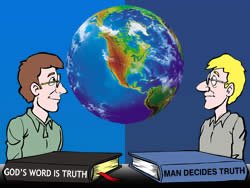
It is important to recognize that people’s presuppositions influence the way they interpret evidence. Evolution is based on a reasoning process that rejects God. Creation starts from the authority of God’s Word. Your presuppositions are like a pair of glasses that you wear to look at the world around you.
Evolution fits this definition of theory, but it relies on the assumption of naturalism. In the naturalistic scientific community, evolution has become a theory that is assumed to be an established fact and not an explanation. Evolution is the prevailing paradigm, and most scientists have stopped questioning the underlying assumptions that the theory is based upon. Creationists develop theories, too, in light of biblical truth, but they are not as widely accepted by scientists. All interpretations (theories) of the past are based on assumptions and cannot be equated with facts that are observable in the present. This holds true for creationist or evolutionist theories. (See article 1:3 on page 29 for more on this topic.)
Evolution also relies heavily on the assumption of uniformitarianism— a belief that the present is the key to the past. According to uniformitarians, the processes in the universe have been occurring at a relatively constant rate. One of these processes is the rate of rock formation and erosion. If rocks form or erode at a certain rate in the present, uniformitarians believe that they must have always formed or eroded at nearly the same rate. This assumption is accepted even though there are no observations of the rate of erosion from the distant past and there is no way to empirically test the erosion rate of the past. However, the Bible makes it very clear that some events of the past were radically different from those we commonly observe today. Noah’s Flood, for example, would have devastated the face of the earth and created a landscape of billions of dead things buried in layers of rock, which is exactly what we see.
Good operational science can provide us with answers to many questions about the world around us and how it operates, but it cannot answer the questions of where we came from and why we are here.
Just as evolutionists weren’t there to see evolution happen over several billion years, neither were creationists there to see the events of the six days of creation. The difference is that creationists have the Creator’s eyewitness account of the events of creation, while evolutionists must create a story to explain origins without the supernatural. Just because many scientists believe the story does not make the story true. Believing the Bible and the information that has been revealed to us by our Creator gives us a foundation for thinking—including our thinking about science. Good operational science can provide us with answers to many questions about the world around us and how it operates, but it cannot answer the questions of where we came from and why we are here. Those questions are outside the scope of operational science. But we are not left without an answer. God has given us the answers to those questions in His Word, the Bible.
Reference Articles
1:1 The nature of science and of theories on origins, Gish, www.icr.org/article/391
Scientific theories must be testable and capable of being proven false. Neither evolution nor biblical creation qualifies as a scientific theory in this sense, because each deals with historical events that cannot be repeated. Both evolution and creation are based on unobserved assumptions about past events. It is inconsistent to say that evolution qualifies as a scientific theory while creation does not. Both have scientific character by attempting to correlate scientific data within a certain framework (model).
No theory of origins can avoid using philosophical statements as a foundation. Creationists use a supernatural act by an Intelligent Designer to explain the origin of the universe and the life we see on earth. Evolutionists do not allow any supernatural explanation as a foundation but insist that only natural laws and processes can be used as explanations. Both are worldviews used to interpret the data. The data is the same; the interpretations arrive at different conclusions based on the starting assumptions. Allowing only evolutionary teaching in public schools promotes an atheistic worldview, just as much as teaching only creation would promote a theistic worldview. Students are indoctrinated to believe they are meaningless products of evolution and that no God exists to whom they are accountable.
Life on earth was either created or it developed in some progressive manner; there are no other alternatives. While there are many versions of both creation and evolution, both cannot be true.

Making observations about living organisms can increase understanding about many aspects of biology. But it is important to recognize the limitations when you cross into historical science.
1:2 Feedback: A “more glorious” means for creation? Hodge, www.answersingenesis.org/go/glorious
Accepting that God created the universe in the way that He said He did is a common stumbling block for many who want to accept the interpretation promoted by evolutionary scientists. There are many reasons why the God of the Bible would not have used evolution and the big bang to create the universe. Those who hold to this position are putting man’s fallible interpretation of scientific data into the text of Genesis.
Accepting the big bang or evolution as factual accounts of the origin of life and the universe is not scientific. They are interpretations of facts. The assumptions that underlie the interpretations are based on the idea that man can determine truth independent of God. Operational science is based on repeatable observations and falsifiable statements while historical science is based on interpreting data that cannot be repeated. Operational science leads to computers and space shuttles as products of repeatable processes. Historical science leads to shifting interpretations that are not reliable.
The only way to arrive at a true interpretation is to start with true assumptions. Since the Bible is the eyewitness account of the Creator of the universe, it is the best starting point for interpreting past events.
1:3 Creation: Where’s the proof? Ham, www.answersingenesis.org/go/proof
All scientists, creationist or evolutionist, have the same evidence; the difference is the presuppositions that are used to interpret that evidence. All reasoning is based on presuppositions. Biblical creationists start with the assumption that the Bible provides an accurate eyewitness history of the universe as a basis for scientific thought. Evolutionists begin with the presupposition that only natural laws can be used to explain the facts. Facts exist in the present, and our interpretations are an attempt to connect the past to the present. The evolutionists must assume everything about the past, while biblical creationists have the Bible as a “time machine” that can provide valuable insight into the past.
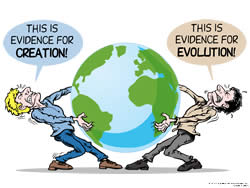
It is not true to say that there is different evidence for creation and evolution. Everyone has the same evidence—it is just interpreted in different ways.
If someone expects you to argue that the Bible or creation is true without using the Bible as evidence, they are stacking the deck in their favor. They are insisting that facts are neutral and that truth can be determined independent of God. Facts are always interpreted, and the Word of God is absolutely trustworthy. Demonstrating how the Bible can be used to effectively explain a fact, like the presence of fossils, demonstrates that it is valid as a filter for interpreting facts. Many people do not realize how their presuppositions impact their thinking. Exposing a person’s presuppositions will help them to see how they filter the facts, and then challenging the origin of those presuppositions will force them to evaluate their stance.
If science depends on naturalistic explanations, it must accept that our thoughts are simply the products of chemical reactions that evolved from random chance. How can you ultimately rely on randomness to evolve the correct way of thinking? If there is no God, ultimately, philosophically, how can one talk about reality? How can one even rationally believe that there is such a thing as truth, let alone decide what it is?
Questions to Consider
- Do all scientists believe in naturalistic evolution? Why or why not?
- There are two contenders for the history of life on earth: some form of naturalism (evolution) or supernatural creation. Are there really any alternatives to some form of naturalistic evolution in science if science is restricted to naturalism?
- Since evolution and creation are both based on religious beliefs, why should one be taught in public schools and not the other?
- Should there be a distinction between experimental (operational) science and historical science?
- Since a naturalistic approach to science can only refer to materialistic explanations, how can naturalists use logic if logic is not a material part of the universe?
- Is it necessary for science to allow only naturalism?
- Would all scientific thought and advancement end if supernatural creation was accepted as a possible model for how the universe and life on earth began?
- Why is supernatural creation considered to be a “science stopper” and not a “science starter,” considering that most of the founding fathers of science believed in the Bible and a supernatural creation event?
- If an all-knowing Creator God exists, wouldn’t it be logical to say that He knows about the scientific laws He created? Why not use what He says as a foundation for scientific thinking?
Tools for Digging Deeper
(see a complete list in the Introduction)
The Biblical Basis for Modern Science by Henry Morris
Creation: Facts of Life by Gary Parker
Creation Scientists Answer Their Critics by Duane Gish
Darwin on Trial by Phillip Johnson
Darwin’s Black Box by Michael Behe
In Six Days by John Ashton
Men of Science, Men of God by Henry Morris
On the Seventh Day by John Ashton
Evolution Exposed: Biology

This book helps teens discern the chronic bias towards belief in evolution that permeates today’s three most popular high school biology textbooks.
Read Online Buy Book
Master Books has graciously granted AiG permission to publish selected chapters of this book online. To purchase a copy please visit our online store.

Support the creation/gospel message by donating or getting involved!

Answers in Genesis is an apologetics ministry, dedicated to helping Christians defend their faith and proclaim the good news of Jesus Christ.
- Customer Service 800.778.3390
- Available Monday–Friday | 9 AM–5 PM ET
- © 2026 Answers in Genesis