

Chapter 6
Where Did the Idea of “Millions of Years” Come From?
Many teach the earth is billions of years old: how this idea took root in the church and in scientific community despite the biblical record.
by
Dr. Terry Mortenson
on
April 22, 2010
; last featured
November 1, 2021
Republished with permission and featured in
The New Answers Book 2
Also available in Deutsch
This chapter, adapted from the book War of the Worldviews, was graciously provided at no charge to Answers in Genesis by Master Books, a division of New Leaf Press (Green Forest, Arkansas).
Today, most people in the world, including most people in the Church, take for granted that the earth and universe are millions and millions (even billions) of years old. Our public schools, from kindergarten on up, teach these vast ages, and one is scoffed at if he questions them. But it has not always been that way, and it is important to understand how this change took place and why.
Geology’s Early Beginnings
Many believed that the fossils were the remains of former living things turned to stone, and many early Christians . . . attributed them to Noah’s Flood.
Geology, as a separate field of science with systematic field studies, collection and classification of rocks and fossils, and development of theoretical reconstructions of the historical events that formed those rock layers and fossils, is only about 200 years old. Prior to this, back to ancient Greek times, people had noticed fossils in the rocks. Many believed that the fossils were the remains of former living things turned to stone, and many early Christians (including Tertullian, Chrysostom, and Augustine) attributed them to Noah’s Flood. But others rejected these ideas and regarded fossils as either jokes of nature, the products of rocks endowed with life in some sense, the creative works of God, or perhaps even the deceptions of Satan. The debate was finally settled when Robert Hooke (1635–1703) confirmed by microscopic analysis of fossil wood that fossils were the mineralized remains of former living creatures.
Prior to 1750, one of the most important geological thinkers was Niels Steensen (1638–1686), or Steno, a Danish anatomist and geologist. He established the principle of superposition, namely that sedimentary rock layers are deposited in a successive, essentially horizontal fashion, so that a lower stratum was deposited before the one above it. In his book Forerunner (1669), he expressed belief in a roughly 6,000-year-old earth and that fossil-bearing rock strata were deposited by Noah’s flood. Over the next century, several authors, including the English geologist John Woodward (1665–1722) and the German geologist Johann Lehmann (1719–1767), wrote books essentially reinforcing that view.
In the latter decades of the 18th century, some French and Italian geologists rejected the biblical account of the Flood and attributed the rock record to natural processes occurring over a long period of time. Several prominent Frenchmen also contributed to the idea of millions of years. The widely respected scientist Comte de Buffon (1707–1788) imagined in his book Epochs of Nature (1779) that the earth was once like a hot molten ball that had cooled to reach its present state over about 75,000 years (though his unpublished manuscript says about 3,000,000 years). The astronomer Pierre Laplace (1749–1827) proposed the nebular hypothesis in his Exposition of the System of the Universe (1796). This theory said that the solar system was once a hot, spinning gas cloud, that over long ages gradually cooled and condensed to form the planets. Jean Lamarck, a specialist in shell creatures, advocated a theory of biological evolution over long ages in his Philosophy of Zoology (1809).
Abraham Werner (1749–1817) was a popular mineralogy professor in Germany. He believed that most of the crust of the earth had been precipitated chemically or mechanically by a slowly receding global ocean over the course of about a million years. It was an elegantly simple theory, but Werner failed to take into account the fossils in the rocks. This was a serious mistake, since the fossils tell much about when and how quickly the sediments were deposited and transformed into stone. Many of the greatest geologists of the 19th century were Werner’s students, who were impacted by his idea of a very long history for the earth.
In Scotland, James Hutton (1726–1797) was developing a different theory of earth history. He studied medicine at the university. After his studies, he took over the family farm for a while. But he soon discovered his real love: the study of the earth. In 1788 he published a journal article and in 1795 a book, both by the title Theory of the Earth. He proposed that the continents were being slowly eroded into the oceans. Those sediments were gradually hardened by the internal heat of the earth and then raised by convulsions to become new landmasses that would later be eroded into the oceans, hardened, and elevated. So in his view, earth history was cyclical, and he stated that he could find no evidence of a beginning in the rock record, making earth history indefinitely long.
Catastrophist—Uniformitarian Debate
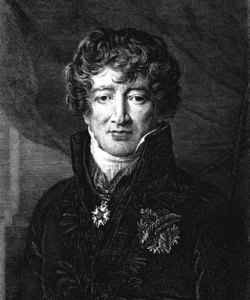
Georges Cuvier (1768–1832)
Neither Werner nor Hutton paid much attention to the fossils. However, in the early 1800s, Georges Cuvier (1768–1832), the famous French comparative anatomist and vertebrate paleontologist, developed his catastrophist theory of earth history. It was expressed most clearly in his Discourse on the Revolutions of the Surface of the Globe (1812). Cuvier believed that over the course of long, untold ages of earth history, many catastrophic floods of regional or nearly global extent had destroyed and buried creatures in sediments. All but one of these catastrophes occurred before the creation of man.
William Smith (1769–1839) was a drainage engineer and surveyor who in the course of his work around Great Britain became fascinated with the strata and fossils. Like Cuvier, he had an old-earth catastrophist view of earth history. In three works published from 1815 to 1817, he presented the first geological map of England and Wales and explained an order and relative chronology of the rock formations as defined by certain characteristic (index) fossils. He became known as the “Father of English Stratigraphy” because he developed the method of giving relative dates to the rock layers on the basis of the fossils found in them.
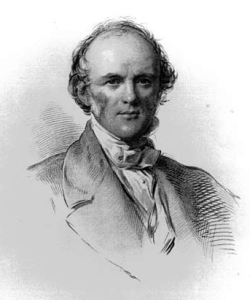
Charles Lyell (1797–1875)
A massive blow to catastrophism came during the years 1830 to 1833, when Charles Lyell (1797–1875), a lawyer and former student of Buckland, published his influential three-volume work Principles of Geology. Reviving and augmenting the ideas of Hutton, Lyell’s Principles set forth the principles by which he thought geological interpretations should be made. His theory was a radical uniformitarianism in which he insisted that only present-day processes of geological change at present-day rates of intensity and magnitude should be used to interpret the rock record of past geological activity. In other words, geological processes of change have been uniform throughout earth history. No continental or global catastrophic floods have ever occurred, insisted Lyell.
Lyell is often given too much credit (or blame) for destroying faith in the Genesis Flood and the biblical time scale. But we must realize that many Christians (geologists and theologians) contributed to this undermining of biblical teaching before Lyell’s book appeared. Although the catastrophist theory had greatly reduced the geological significance of Noah’s flood and expanded earth history well beyond the traditional biblical view, Lyell’s work was the final blow for belief in the Flood. By explaining the whole rock record by slow, gradual processes, he thereby reduced the Flood to a geological nonevent. Catastrophism did not die out immediately, although by the late 1830s only a few catastrophists remained, and they believed Noah’s flood was geologically insignificant.
By the end of the 19th century, the age of the earth was considered by all geologists to be in the hundreds of millions of years. Radiometric dating methods began to be developed in 1903, and over the course of the 20th century that age of the earth expanded to 4.5 billion years.
Christian Responses to Old-Earth Geology
During the first half of the 19th century, the Church responded in various ways to these old-earth theories of the catastrophists and uniformitarians. A number of writers in Great Britain (and a few in America), who became known as “scriptural geologists,” raised biblical, geological, and philosophical arguments against the old-earth theories. Some of them were scientists and some were clergy. Some were both ordained and scientifically well informed, as was common in those days. Many of them were very geologically competent by the standards of their day, both by reading and by their own careful observations of rocks and fossils. They believed that the biblical account of creation and Noah’s flood explained the rock record far better than the old-earth theories.1
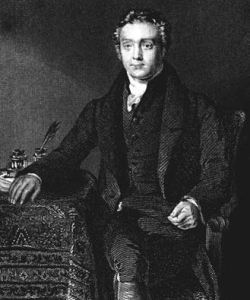
Thomas Chalmers (1780–1847)
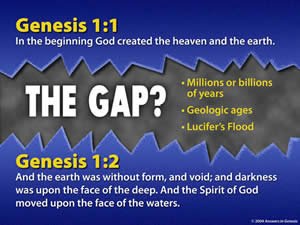
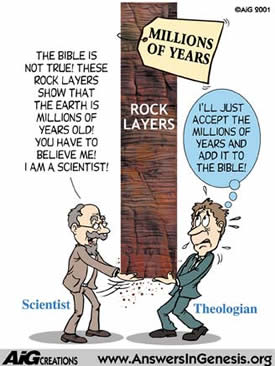
Other Christians in the early 1800s quickly accepted the idea of millions of years and tried to fit all this time into Genesis, even though the uniformitarians and catastrophists were still debating and geology was in its infancy as a science. In 1804, Thomas Chalmers (1780–1847), a young Presbyterian pastor, began to preach that Christians should accept the millions of years; and in an 1814 review of Cuvier’s book, he proposed that all the time could fit between Genesis 1:1 and 1:2. By that time, Chalmers was becoming a highly influential evangelical leader and, consequently, this gap theory became very popular. In 1823, the respected Anglican theologian George Stanley Faber (1773–1854) began to advocate the day-age view, namely that the days of creation were not literal but figurative for long ages.
To accept these geological ages, Christians also had to reinterpret the Flood. In the 1820s, John Fleming (1785–1857), a Presbyterian minister, contended that Noah’s Flood was so peaceful that it left no lasting geological evidence. John Pye Smith (1774–1851), a Congregational theologian, preferred to see it as a localized inundation in the Mesopotamian valley (modern-day Iraq).
Liberal theology, which by the early 1800s was dominating the Church in Europe, was beginning to make inroads into Britain and North America in the 1820s. The liberals considered Genesis 1–11 to be as historically unreliable and unscientific as the creation and flood myths of the ancient Babylonians, Sumerians, and Egyptians.
In spite of the efforts of the scriptural geologists, these various old-earth reinterpretations of Genesis prevailed, so that by 1845 all the commentaries on Genesis had abandoned the biblical chronology and the global flood; and by the time of Darwin’s Origin of Species (1859), the young-earth view had essentially disappeared within the Church. From that time onward, most Christian leaders and scholars of the Church accepted the millions of years and insisted that the age of the earth was not important. Many godly men soon accepted evolution as well. Space allows only mention of a few examples. The Baptist “prince of preachers” Charles Spurgeon (1834–1892) uncritically accepted the old-earth geological theory (though he never explained how to fit the long ages into the Bible). In an 1855 sermon he said:
Can any man tell me when the beginning was? Years ago we thought the beginning of this world was when Adam came upon it; but we have discovered that thousands of years before that God was preparing chaotic matter to make it a fit abode for man, putting races of creatures upon it, who might die and leave behind the marks of his handiwork and marvelous skill, before he tried his hand on man.2
The great Presbyterian theologian at Princeton Seminary, Charles Hodge (1797–1878), insisted that the age of the earth was not important. He favored the gap theory initially and switched to the day-age view later in life. His compromise contributed to the eventual victory of liberal theology at Princeton about 50 years after his death.3
C. I. Scofield put the gap theory in notes on Genesis 1:2 in his Scofield Reference Bible, which was used by millions of Christians around the world. More recently, a respected Old Testament scholar reasoned:
From a superficial reading of Genesis 1, the impression would seem to be that the entire creative process took place in six twenty-four-hour days. If this was the true intent of the Hebrew author . . . this seems to run counter to modern scientific research, which indicates that the planet Earth was created several billion years ago. . . .4
Numerous similar statements from Christian scholars and leaders in the last few decades could be quoted to show that their interpretation of Genesis is controlled by the fact that they assume that geologists have proven millions of years. As a result, most seminaries and Christian colleges around the world are compromised.
Compromise Unnecessary
The sad irony of all this compromise is that in the last half-century, the truth of Genesis 1–11 has been increasingly vindicated, often unintentionally, by the work of evolutionists. Lyell’s uniformitarian Principles dominated geology until about the 1970s, when Derek Ager (1923–1993), a prominent British geologist, and others increasingly challenged Lyell’s assumptions and argued that much of the rock record shows evidence of rapid catastrophic erosion or sedimentation, drastically reducing the time involved in the formation of many geological deposits. Ager, an atheist to his death (as far as one can tell from his writings), explained the influence of Lyell on geology this way:
My excuse for this lengthy and amateur digression into history is that I have been trying to show how I think geology got into the hands of the theoreticians [uniformitarians] who were conditioned by the social and political history of their day more than by observations in the field. . . . In other words, we have allowed ourselves to be brain-washed into avoiding any interpretation of the past that involves extreme and what might be termed “catastrophic” processes.5
These “neocatastrophist” reinterpretations of the rocks have developed contemporaneously with a resurgence of “Flood geology,” a view of earth history very similar to that of the 19th-century scriptural geologists and a key ingredient of young-earth creationism, which was essentially launched into the world by the publication of The Genesis Flood (1961) by Drs. John Whitcomb and Henry Morris. This movement is now worldwide in scope, and the scientific sophistication of the scientific model is rapidly increasing with time.
Many Christians today are arguing that we need to contend against Darwinism with “intelligent design” arguments and leave Genesis out of the public discussion. But this strategy was tried in the early 19th century with many writings on natural theology, culminating in the famous eight volumes of the 1830s that collectively became known as the Bridgewater Treatises. These books were “preaching to the choir” and did nothing to retard the slide in the culture toward atheism and deism. In fact, by compromising on the age of the earth and ignoring Scripture in their defense of Christianity, they actually contributed to the weakening of the Church. The same is happening today.
The renowned atheist evolutionist and Harvard University biologist Ernst Mayr said this:
The [Darwinian] revolution began when it became obvious that the earth was very ancient rather than having been created only 6,000 years ago. This finding was the snowball that started the whole avalanche.6
Mayr was right about the age of the earth (not Darwin’s theory) being the beginning of the avalanche of unbelief. He was wrong that the idea of millions of years was a “finding” of scientific research. Rather, it was the fruit of antibiblical philosophical assumptions used to interpret the rocks and fossils. Historical research has shown that Laplace was an open atheist, that Buffon, Lamarck, Werner, and Hutton were deists or atheists, and that Cuvier, William Smith, and Lyell were deists or vague theists. These men (who influenced the thinking of compromised Christians) were NOT unbiased, objective pursuers of truth.
Typical of what Lyell, Buffon, and others wrote is Hutton’s statement. He insisted, “The past history of our globe must be explained by what can be seen to be happening now. . . . No powers are to be employed that are not natural to the globe, no action to be admitted except those of which we know the principle.”7 By insisting that geologists must reason only from known, present-day natural processes, he ruled out supernatural creation and the unique global Flood, as described in Genesis, before he ever looked at the rocks.
It is no wonder that Hutton could not see the overwhelming geological evidence confirming the biblical teaching about creation, the Flood, and the age of the earth. And no wonder all the geology students who have been brainwashed with the same presuppositions for the last 200 years haven’t been able to see it either. We should not be surprised that most Christian leaders and scholars are ignorant of the evidence. They, too, have been brainwashed, as many young-earth creationists once were also.
Disastrous Consequences of Compromise
The scriptural geologists of the early 19th century opposed old-earth geological theories not only because the theories reflected erroneous scientific reasoning and were contrary to Scripture, but also because they believed that Christian compromise with such theories would eventually have a catastrophic effect on the health of the Church and her witness to a lost world. Henry Cole, an Anglican minister, wrote:
Many reverend geologists, however, would evince their reverence for the divine Revelation by making a distinction between its historical and its moral portions; and maintaining, that the latter only is inspired and absolute Truth; but that the former is not so; and therefore is open to any latitude of philosophic and scientific interpretation, modification or denial! According to these impious and infidel modifiers and separators, there is not one third of the Word of God that is inspired; for not more, nor perhaps so much, of that Word, is occupied in abstract moral revelation, instruction, and precept. The other two thirds, therefore, are open to any scientific modification and interpretation; or, (if scientifically required), to a total denial! It may however be safely asserted, that whoever professedly, before men, disbelieves the inspiration of any part of Revelation, disbelieves, in the sight of God, its inspiration altogether. . . . What the consequences of such things must be to a revelation-possessing land, time will rapidly and awfully unfold in its opening pages of national skepticism, infidelity, and apostasy, and of God’s righteous vengeance on the same!8
Cole and other opponents of the old-earth theories rightly understood that the historical portions of the Bible (including Genesis 1–11) are foundational to the theological and moral teachings of Scripture. Destroy the credibility of the former, and sooner or later you will see rejection of the latter, both inside and outside the Church. If the scriptural geologists were alive today and saw the castle diagram shown below, they would say, “That picture’s exactly what we were concerned about!” The history of the once- Christian nations in Europe and North America has confirmed the scriptural geologists’ worst fears about the Church and society.
It is time for the Church, especially her leaders and scholars, to stop ignoring the age of the earth and the scientific evidence that increasingly vindicates the Word of God. Christians must repent of their compromise with millions of years and once again believe and preach the literal truth of Genesis 1–11. It is time to take our culture back.

The New Answers Book 2
In The New Answers Book 2 you’ll find 31 more great answers to big questions for the Christian life.
Read Online Buy BookFootnotes
- See T. Mortenson, The Great Turning Point: The Church’s Catastrophic Mistake on Geology—Before Darwin (Green Forest, AR: Master Books, 2004) for a full discussion of these men and the battle they fought against these developing old-earth theories and Christian compromises.
- C.H. Spurgeon, “Election,” The New Park Street Pulpit 1 (1990): 318.
- See J. Pipa and D. Hall, eds., Did God Create in Six Days? (Whitehall, WV: Tolle Lege Press, 2005), p. 7–16, for some of the documentation of this sad slide into apostasy.
- G. Archer, A Survey of Old Testament Introduction (Chicago, IL: Moody Press, 1985), p. 187.
- D. Ager, The Nature of the Stratigraphical Record (New York: Wiley, 1981), p. 46–47.
- E. Mayr, “The Nature of the Darwinian Revolution,” Science 176 (1972): 988.
- J. Hutton, “Theory of the Earth,” Trans. of the Royal Society of Edinburgh, 1788, quoted in A. Holmes, Principles of Physical Geology (New York: Ronald Press Co., 1965), p. 43–44.
- H. Cole, Popular Geology Subversive of Divine Revelation (London: Hatchard and Son, 1834), p. ix–x, 44–45 footnote.



Support the creation/gospel message by donating or getting involved!

Answers in Genesis is an apologetics ministry, dedicated to helping Christians defend their faith and proclaim the good news of Jesus Christ.
- Customer Service 800.778.3390
- Available Monday–Friday | 9 AM–5 PM ET
- © 2026 Answers in Genesis